


Summary
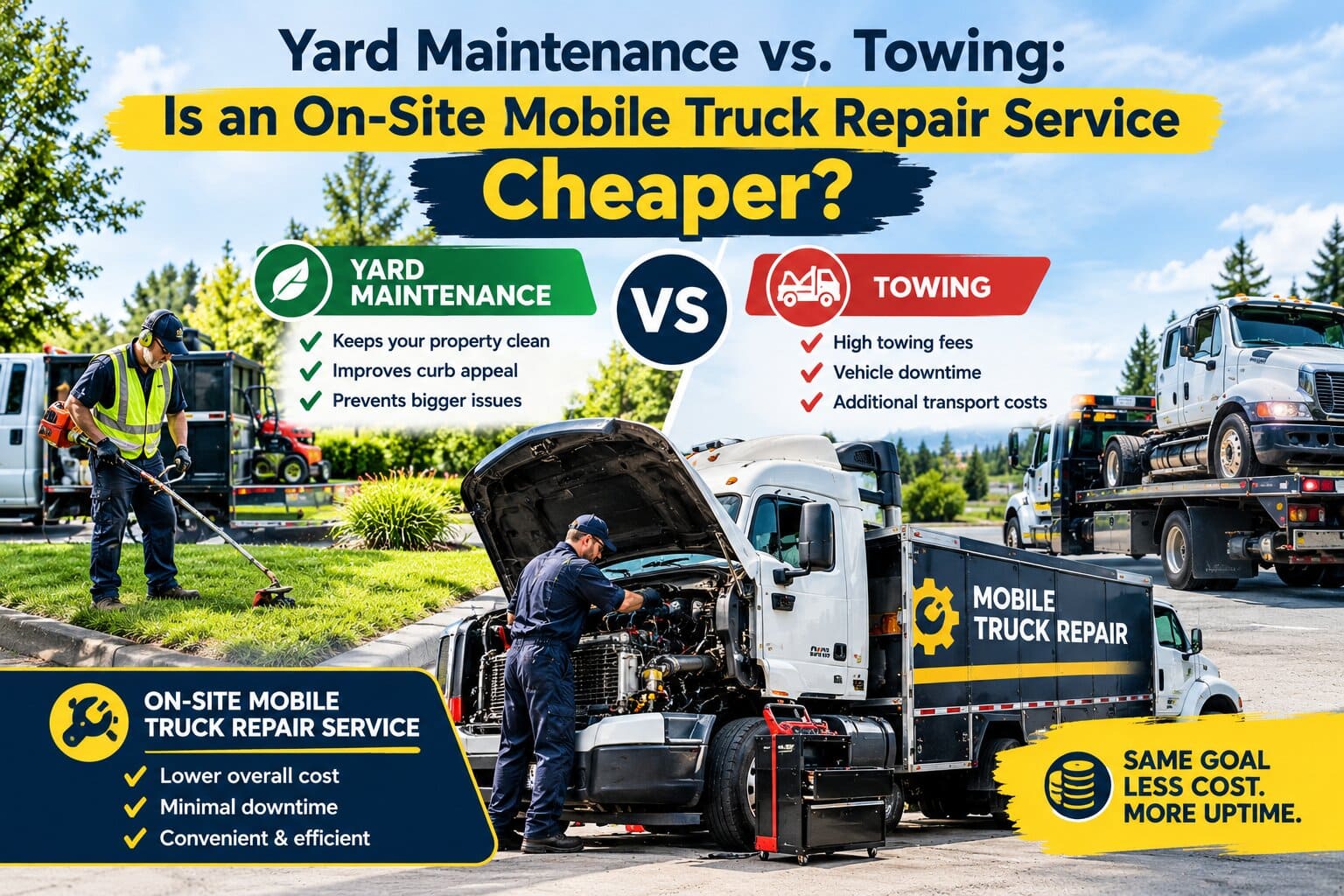
- Compare the true financial impact of towing commercial rigs versus dispatching a mobile truck repair service directly to your facility.
- Understand the hidden expenses behind heavy-duty wrecker invoices, including hook fees, mileage surcharges, and off-site drop storage.
- Discover how scheduling routine fleet maintenance inside your terminal prevents unscheduled breakdowns and lowers labor overhead.
- Calculate the real-world operational savings achieved by cutting commercial fleet downtime and eliminating deadhead transit hours.
- Explore how integrated mechanical and equipment rental support protects profit margins for regional logistics and vocational fleets.
Keeping a fleet of commercial freight haulers, dump trucks, or service vehicles rolling is a delicate balancing act between operating speed and budget control. When an unexpected breakdown occurs or standard maintenance intervals come due, fleet managers face an immediate financial decision: hook the truck to a wrecker and drag it across town to a brick-and-mortar dealer, or dispatch an on-site technician directly to where the iron is parked.
While calling a wrecker often feels like the default reflex, contracting a dedicated mobile truck repair service has quickly proven to be the smarter, more economical strategy for modern logistics operations. In Eatonville, Washington, and across surrounding communities, fleet managers rely on the experienced crew at Williams Diesel LLC to deliver dependable, affordable solutions spanning everything from small diesel engine repair and heavy duty diesel engine repair to comprehensive fleet management.
Understanding the true mathematics behind fleet maintenance requires looking past simple hourly labor rates. When you evaluate the secondary expenses that pile up whenever a rig is towed, the financial advantages of mobile yard care become unmistakable.
Start a WhatsApp chat and grab your free quote today :
Breaking Down Heavy-Duty Towing Costs
Calling a commercial towing provider to recover a Class 7 or Class 8 tractor-trailer is never cheap. Heavy wrecker companies operate multi-million-dollar recovery rigs with immense overhead, insurance premiums, and specialized rigging gear, and those operating costs are passed directly to fleet operators on every invoice.
A typical invoice for hauling a disabled semi-truck rarely consists of a flat rate. Instead, it is packed with line-item surcharges that accumulate rapidly:
- Base Hookup Fees: Simply connecting a commercial heavy wrecker to a tandem-axle tractor starts with a substantial baseline hook charge, frequently running between $350 and $600 before the wheels ever turn.
- Per-Mile Loaded Rates: Heavy wreckers bill premium per-mile rates ranging from $15 to $35 per mile. In congested transit routes across Western Washington, a 20-mile tow to an authorized regional dealer can easily add hundreds of dollars to the trip.
- Driveline and Axle Disconnect Labor: Towing heavy transmissions requires removing drive shafts or pulling rear half-shafts to protect differential gears from turning without lubrication during transit. Wrecker operators bill separate mechanical labor fees to perform this prep work.
- Auxiliary Air Line Hookups: Connecting secondary air to release spring brakes and power trailer signal lamps adds administrative and roadside hookup fees.
When you total up these individual charges, standard heavy-duty towing costs routinely exceed $800 to $1,500 per incident—even for minor issues like broken fan belts, gelled fuel filters, or failed air governors that take under an hour to repair on site.
The Hidden Drain: Commercial Truck Downtime
While an expensive wrecker invoice hurts monthly cash flow, the largest financial drain on any transport company is commercial truck downtime. In commercial freight and local construction logistics, a parked truck produces zero revenue while continuing to consume fixed costs such as equipment financing notes, commercial insurance premiums, driver retention pay, and permit fees.
When a truck is towed to a franchise dealership or large metropolitan shop, it enters a service queue behind dozens of other fleet vehicles. Even for a minor sensor failure or starter replacement, your asset may sit parked in an overflow yard for two to four days before an intake technician even connects a diagnostic scanner.
During that window, the financial losses multiply:
- Missed Delivery Windows: Failure to meet contracted dock appointments can trigger liquidated damages, chargebacks, and damaged shipper relationships.
- Driver Idling & Detention Costs: Drivers forced to wait on stranded equipment must still be compensated, accommodated, or shuttled back to corporate terminals.
- Dispatch Rescheduling: Moving freight to spare capacity or outsourcing loads to spot-market brokerage boards eats directly into operating margins.
By hiring a dedicated mobile diesel mechanic Seattle crews can depend on, the diagnostic and wrench time starts the moment the service truck pulls into your lot. Technicians troubleshoot faults immediately, source parts locally, and execute repairs on the spot, turning days of backlog into a few hours of downtime.
On-Site Fleet Maintenance: Transforming the Yard into a Service Bay
Rather than reacting to roadside catastrophes, forward-thinking fleet superintendents are moving their operational strategy toward scheduled on-site fleet maintenance. Instead of shuttling vehicles across town, an equipped service truck brings professional tooling, fluid evacuation pumps, and digital ECM scanners right to your staging yard.
Technicians can work during scheduled rest cycles, between delivery runs, or over weekends when equipment is already idle. This setup allows multiple tractors, medium-duty box trucks, and vocational trailers to be serviced simultaneously in a single yard visit.
This systematic approach eliminates deadhead transit miles and minimizes driver logistical coordination. Most importantly, it catches small component failures—such as fraying serpentine belts, worn air brake chambers, or pinhole coolant leaks—before they strand your equipment on the shoulder of a busy interstate.
Equipment Rental and Integrated Field Support
For heavy construction contractors and civil earthmoving businesses, vocational trucks work hand in hand with heavy iron on tight project sites. Dump trucks, equipment haulers, and fuel trucks must operate alongside excavators, track loaders, and skid steers without missing a beat.
In this fast-paced construction sector, Equipment Rental plays an essential operational role. When primary machinery is down for component overhauls, renting late-model mini excavators, attachments, or heavy hauling support units ensures job-site milestones are met without penalizing client schedules.
When your equipment rental partners also understand the mechanical engineering behind commercial machinery, job-site efficiency jumps significantly. Finding an integrated provider capable of handling precision william diesel repairs alongside rental equipment logistics allows contractors to source both job-ready machines and dependable field mechanics from a single trusted regional vendor.
Emergency Roadside Assistance vs. Scheduled Fleet PM
While scheduled fleet care is the best way to prevent breakdowns, mechanical failures are an inevitable reality of heavy transportation. High operating temperatures, heavy mountain payloads, and winter road grime push engine components to their structural limits.
Understanding when to leverage scheduled service versus on-demand roadside response is essential for maintaining control over operational budgets.
| Operational Factor | Scheduled Fleet Preventive Maintenance | Emergency Roadside Truck Repair |
| Primary Objective | Catch component wear early & maintain DOT compliance | Rapid repair of sudden disablements to clear the highway |
| Timing & Scheduling | Planned around driver shifts and low-volume hours | Immediate on-demand dispatch (24/7 responsiveness) |
| Typical Tasks | Oil/filter analysis, valve lashes, brake adjustments | Blown air lines, broken belts, frozen brakes, fuel gel |
| Cost Profile | Predictable, discounted contract hourly rates | Callout fees plus priority roadside labor rates |
| Impact on Operations | Zero unplanned downtime; consistent reliability | Minimizes towing fees and clears high-risk travel lanes |
By prioritizing scheduled fleet preventive maintenance, you resolve emerging mechanical issues on your own timeline. When an unexpected highway breakdown does occur, having an established relationship with an emergency roadside truck repair service ensures that your driver receives prompt, safe, and professional assistance without resorting to an expensive wrecker.
Diagnostics and Mechanical Scope of Modern Mobile Units
A common misconception among newer fleet managers is that mobile service units are only equipped to handle basic tire swaps or jump starts. In reality, modern mobile diesel service trucks are self-contained mobile workshops engineered to complete advanced heavy diesel repair in the field.
Today’s mobile field units are outfitted with industrial-grade support equipment:
- Advanced ECM Diagnostic Scanners: Factory-level software capable of connecting to Cummins, Detroit Diesel, PACCAR, Volvo, and Mack engine control modules to read fault codes, initiate forced DPF regenerations, and run cylinder cutout tests.
- Onboard Power & Pneumatics: Engine-driven rotary screw air compressors providing the CFM needed to run heavy impact wrenches and pneumatic torque multipliers.
- Fluid Transfer Systems: Fresh oil delivery reels, pressurized waste oil evacuation tanks, and anti-freeze recovery setups that comply with strict Washington Department of Ecology spill-containment regulations.
- Oxy-Acetylene Torches & Mobile Welders: Equipment capable of cutting, heating frozen pins, and fabricating structural brackets or trailer subframes right in your yard.
From replacing failed water pumps and rebuilding frozen brake calipers to troubleshooting intricate multiplex wiring harnesses, fully equipped mobile technicians can execute complex repairs on-site, entirely eliminating the need for towing.
Evaluating Regional Service Quality in Western Washington
For operators moving freight through the Interstate 5 corridor, State Route 167, and Highway 512, traffic congestion makes regional logistics a daily challenge. A breakdown anywhere near the Port of Tacoma or south King County can stall regional commerce for hours.
Having access to experienced truck repair seattle wa operations ensures that equipment issues are met with rapid response times and deep technical knowledge. Choosing a local service provider with field-proven diagnostic expertise means your driver won’t be left stranded for hours on a dangerous highway shoulder waiting for a tow truck from fifty miles away.
For companies managing cross-town logistics, choosing an established provider for seattle mobile truck repair keeps your assets running efficiently without the inflated shop rates and scheduling gridlock common at major urban truck dealerships.
Puget Sound Operating Advantages of Mobile Service:
- Rapid I-5 / Hwy 167 corridor deployment
- Direct terminal servicing during driver rest periods
- Elimination of Seattle-Tacoma urban towing fees
- Experienced technicians familiar with PNW weather wear & rust
Local FAQs: On-Site Truck Repair & Yard Maintenance
Q1: What specific geographic areas and transport corridors do your mobile units service?
Mobile service units cover commercial yards, distribution hubs, and construction jobsites across Western Washington. Core service zones include Eatonville, Tacoma, Puyallup, Kent, Auburn, Seattle, and adjacent communities along the I-5, SR-167, and SR-512 corridors.
Q2: What is the typical local response time for mobile roadside and yard dispatch?
For scheduled yard maintenance, appointments are locked in around your fleet’s resting hours. For emergency roadside service, mobile units are typically dispatched immediately, with local arrival times averaging between 45 and 90 minutes depending on current traffic conditions, adverse weather, and your exact milepost.
Q3: Are mobile diesel mechanics fully equipped to handle major mechanical failures on-site?
Yes. Mobile service trucks carry computerized engine diagnostic laptops, heavy-duty pneumatic tooling, welding and cutting gear, high-output jump starters, and specialized fluid handling systems. Mechanics can resolve air system failures, cooling leaks, fuel delivery problems, electrical faults, and complex brake issues right where the vehicle sits.
Q4: How does on-site fleet maintenance help our business pass state and federal DOT inspections?
Mobile technicians conduct rigorous multi-point commercial vehicle inspections that mirror Washington State Patrol and Federal Motor Carrier Safety Administration (FMCSA) standards. Identifying chafing brake lines, worn pushrod travel, steering play, or faulty marker lamps in your yard ensures your trucks roll through weigh stations and roadside inspections without costly out-of-service violations.
Q5: Is mobile maintenance practical for mixed fleets of light, medium, and heavy equipment?
Absolutely. Most commercial fleets consist of a mix of Class 8 tractors, Class 4-6 delivery trucks, and support pickups. Experienced mobile technicians have the broad diagnostic tooling and mechanical skills required to service diverse powertrains simultaneously in a single scheduled yard visit.
Conclusion: Driving Fleet Profitability with On-Site Care
When evaluating whether mobile service is cheaper than towing, the data presents a clear verdict. While commercial towing adds steep hook fees, premium mileage rates, and days of idle yard backlog to your operating expenses, choosing an on-site mobile truck repair service directly preserves your working capital. By taking care of diagnostics, preventative maintenance, and mechanical repairs right in your yard, you slash vehicle downtime, keep drivers productive, and eliminate towing invoices completely.
Whether you are searching for dependable williams equipment rental near me to keep a commercial earthmoving project on schedule, vetting a trusted heavy duty repair shop near me for comprehensive shop overhauls, or needing an experienced mobile diesel mechanic near me to troubleshoot a stalled tractor, local experience matters.
For dependable, affordable, and certified diesel maintenance spanning small diesel engine repair and heavy duty diesel engine repair in Eatonville, Washington, and across the greater South Sound region, partner with the trusted professionals at Williams Diesel LLC.

Comments are closed