


Summary
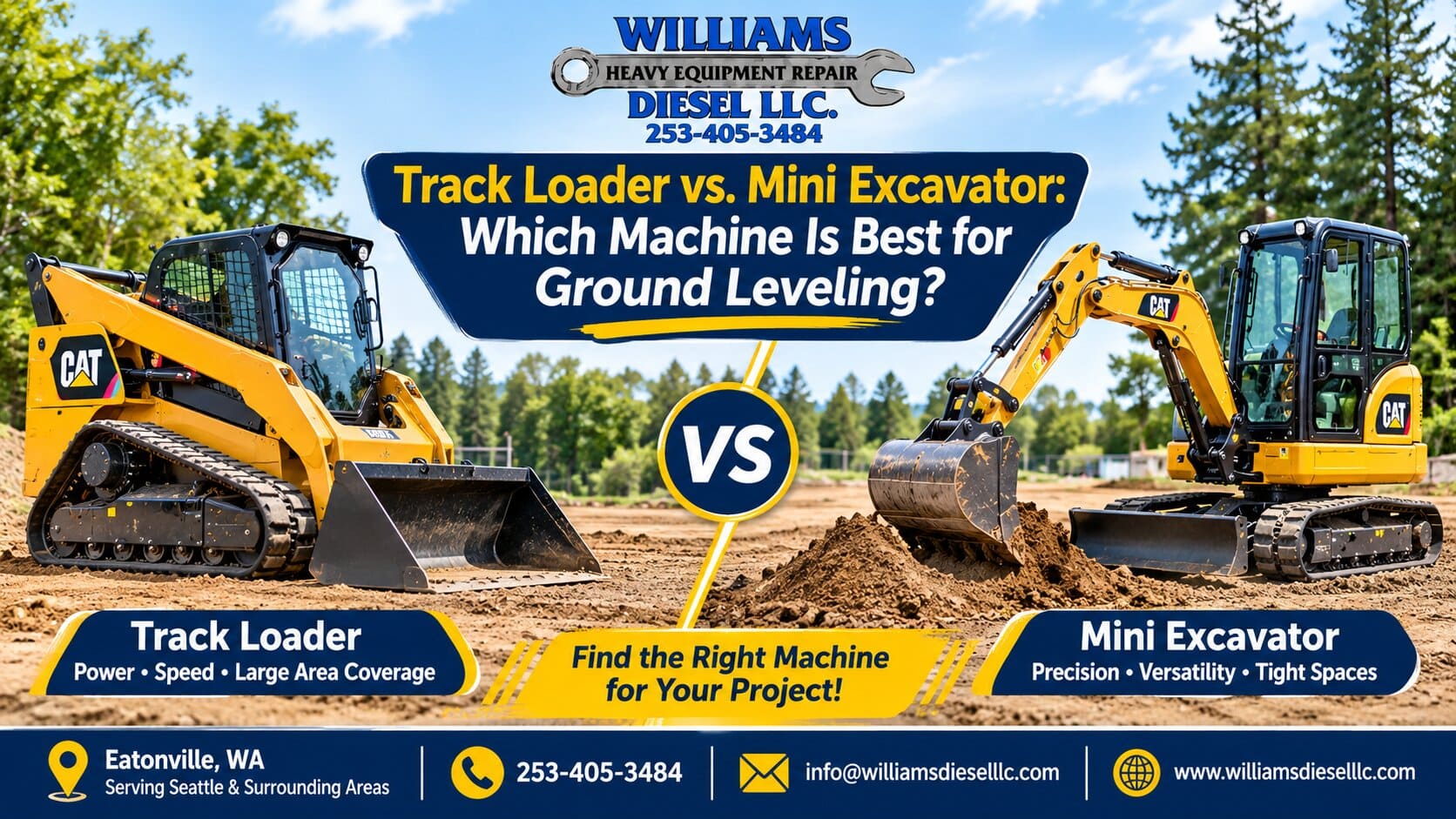
- Effective ground leveling depends on matching machine geometry, blade design, and hydraulic reach to your specific jobsite layout.
- Tracked loaders dominate wide, open surfaces where pushing bulk material, spreading aggregate, and back-dragging deliver maximum speed.
- Compact excavators excel on sloped terrain, tight side yards, and precision ditch or terrace shaping where articulated reach matters.
- Swapping toothed digging buckets for smooth-lip grading attachments prevents soil gouging and creates clean, uniform subgrades.
- Renting specialized earthmoving machinery locally provides late-model reliability, fast attachment swaps, and flexible project timelines.
Preparing an uneven lot for a concrete slab, gravel driveway, or new lawn requires choosing the right earthmoving iron before moving a single cubic yard of soil. When tackling residential yard regrading or commercial pad prep in the Pacific Northwest, partnering with a dependable fleet provider like Williams Diesel LLC—widely trusted for affordable, professional ground leveling machinery and earthmoving support in Seattle, Washington and surrounding communities—helps ensure your crew matches the proper machine geometry to the terrain.
Selecting the wrong carrier machine for your site layout leads to unnecessary passes, rutted subgrades, and wasted rental hours, whereas picking the right platform turns rough, undulating dirt into a laser-flat foundation in a fraction of the time.
Understanding the mechanical differences between tracked loaders and compact excavators allows contractors, landscapers, and property owners to plan smarter site workflows. Whether you are stripping sod across a wide acreage parcel or sculpting terraced drainage swales around an existing foundation, evaluating how each machine pushes, cuts, and contours soil will save significant labor and fuel costs.
Whether you are regrading a wide gravel driveway or shaping sloped drainage swales, choosing the right machine saves hours on the job. Contact Williams Diesel LLC today to compare track loader and mini excavator rentals with prompt local delivery across Eatonville, Seattle, and Western Washington.
How Tracked Loaders Handle Surface Prep and Bulk Earthmoving
Tracked loaders are engineered from the ground up as high-efficiency pushing, carrying, and grading machines. With low-mounted lift arms, high hydraulic breakout torque, and wide rubber tracks that distribute vehicle weight evenly across soft ground, these machines excel when moving substantial volumes of material across open spaces.
Pushing, Spreading, and Back-Dragging Mechanics
The primary advantage of a tracked loader during site prep lies in its forward pushing power and wide bucket footprint. Operators can shave down high spots by setting the bucket cutting edge at a slight downward pitch, scoop up the excess dirt, carry it across the lot, and dump it directly into low depressions. Once rough elevations are established, tilting the bucket forward and driving in reverse—a technique known as back-dragging—smooths out loose topsoil or crushed gravel into a remarkably consistent plane.
Stability and Flotation on Soft Subgrades
In Western Washington, where damp clay and rain-softened topsoil are common challenges, wheeled skid steers often spin out and churn deep ruts into the very surface you are trying to smooth. By contrast, booking a compact track loader rental gives operators superior flotation and traction. The long, wide track undercarriage bridges minor undulations smoothly, preventing the machine from pitching forward and backward as it travels across uneven terrain. For tight residential gates or narrow backyard pathways where full-sized loaders cannot squeeze through, an agile mini track loader offers similar stand-on maneuverability and low ground pressure in a compact footprint.
Why Compact Excavators Excel at Slopes and Precision Contouring
While tracked loaders shine on flat or gently rolling open lots, compact excavators bring an entirely different mechanical advantage to earthmoving: articulated 360-degree boom reach and independent backfill blade control.
Sculpting Slopes, Ditches, and Terraces
An excavator does not need to drive directly over the ground it is shaping. Parked securely on a stable bench, an operator can swing the upper house smoothly from left to right, pulling the bucket across embankments, drainage swales, and retaining wall tiers with surgical accuracy. If your project involves cutting a French drain trench, shaping a crowned culvert ditch, or grading around delicate septic components and mature tree roots, a mini excavator rental provides unmatched control without risking damage to surrounding structures.
Using the Front Dozer Blade for Backfilling
Nearly every compact excavator features a hydraulically controlled front dozer blade. While primarily designed to stabilize the machine during heavy digging, this front blade doubles as an effective grading tool for pushing spoil piles back into trenches and rough-smoothing narrow access lanes. By locking the blade at a consistent height and tracking forward slowly, operators can knock down uneven ridges efficiently before making final passes with the boom.
Head-to-Head Comparison: Choosing the Right Machine for Your Jobsite
Deciding between these two versatile machines comes down to four practical site variables: surface area, terrain slope, space constraints, and material transport distance.
1. Open Lots, Driveways, and Building Pads
When tackling wide-open ground leveling across a 4,000-square-foot shop pad, regrading a 300-foot gravel driveway, or spreading twenty yards of delivered topsoil across an open yard, the tracked loader wins decisively. Its ability to carry full buckets of aggregate across the site and back-drag wide swaths completes large surface areas three to four times faster than an excavator.
2. Steep Embankments and Multi-Tiered Yards
When working on hillside properties where driving a loader sideways across a slope risks tipping or sliding, an excavator is far safer and more effective. Excavators sit stationary while the boom reaches up or down the grade to pull soil into smooth, uniform terraces.
3. Confined Spaces and Obstacle-Heavy Zones
Backyards with existing decks, brick patios, fence lines, and utility boxes restrict forward-and-reverse loader travel. A zero-tail-swing mini excavator can rotate freely inside tight corners, reaching over garden walls or between trees to smooth soil where a loader cannot maneuver without tearing up existing landscaping.
4. Hauling Dirt Across Long Distances
If excess soil scraped from one corner of your property needs to be relocated 150 feet away to fill a low spot, a tracked loader transports that dirt in its bucket automatically as part of the grading cycle. An excavator, by contrast, can only move dirt within the swing radius of its boom unless paired with a dump trailer or wheel loader.
Essential Attachments That Transform Grading Quality
Even the best carrier machine will struggle to leave a smooth surface if equipped with the wrong bucket. Standard digging buckets feature long, pointed teeth designed to penetrate hard clay and rocky glacial till—which inevitably leave deep grooves behind during surface prep.
Smooth-Lip Grading Buckets
Swapping out a toothed digging bucket for a wide, smooth-edged 48 inch grading bucket immediately transforms finish quality. The flat cutting edge shaves high spots cleanly without digging into the subbase, while the wider profile spans minor ground dips to create an even, table-flat surface. Many grading buckets also feature tilt cylinders that allow operators to angle the bucket edge for cutting precise drainage crowns and sloped shoulders.
Land Plane and Box Blade Attachments
For tracked loaders, specialized land planes and hydraulic box blades feature dual cutting edges and long side skids that automatically plane off bumps and deposit loose dirt into low pockets in a single pass. Exploring versatile excavator attachments rental options—such as hydraulic grading buckets, vibratory plate compactors, and rake attachments—lets contractors tailor a single base machine to handle root raking, slope shaping, and soil compaction without bringing extra carriers onto the site.
Step-by-Step Workflow for Professional Site Prep
Achieving durable, long-lasting results during site grading and leveling requires following a disciplined sequence rather than simply pushing loose dirt over soft spots:
- Strip Organic Topsoil and Debris: Clear away sod, roots, branches, and organic mulch first. Organic matter decomposes over time, creating soft pockets that cause concrete slabs and pavers to sink later.
- Establish Rough Elevations: Cut high ridges and fill low depressions in thin 4-to-6-inch lifts. Avoid dumping deep piles of loose dirt into holes without compacting each layer.
- Verify Drainage Slope: Maintain at least a 1% to 2% fall (roughly one-eighth to one-quarter inch per foot) away from building foundations so Pacific Northwest rainwater drains cleanly away from structures.
- Execute Final Surface Passes: Switch to a smooth-lip bucket or land plane for finish grading, using light downward pressure and overlapping passes to erase track marks.
- Compact the Subgrade: Run a vibratory plate compactor or trench roller over the smoothed soil or crushed rock base before pouring concrete or laying pavers.
Why Strategic Equipment Rental Maximizes Jobsite Efficiency
For independent contractors, landscapers, and property owners, maintaining ownership of multiple specialized earthmoving machines ties up substantial capital in loan payments, storage yards, and preventative maintenance. Leveraging modern Equipment Rental solutions gives builders immediate access to late-model, well-maintained machinery tailored specifically to each phase of construction.
Instead of forcing one owned machine to handle every task poorly, renting lets you deploy a tracked loader for rapid bulk dirt movement on Monday and swap to a compact excavator for precision trenching and slope contouring on Wednesday. Partnering with a dependable heavy equipment rental provider ensures every machine arrives freshly serviced, inspected by certified diesel mechanics, and matched with compatible quick-coupler attachments—eliminating costly breakdowns and keeping bids competitive.
Finding Reliable Earthmoving Equipment Across Western Washington
Coordinating earthmoving schedules in the Puget Sound region requires a fleet partner who understands local soil conditions, tight delivery windows, and residential access constraints. Contractors and landowners across Pierce and King counties regularly search for responsive equipment rental near me when tight project timelines demand prompt drop-off and well-maintained iron.
Whether your project involves delicate residential yard leveling in Eatonville or bulk earthmoving on a major commercial build requiring a large excavator rental near me, working with a knowledgeable local supplier simplifies logistics from start to finish. Serving Seattle, Tacoma, Puyallup, Eatonville, and surrounding communities, regional fleet teams provide transparent daily and weekly rates alongside turnkey jobsite delivery.
Frequently Asked Questions
1. Can I use a toothed digging bucket to level dirt?
While a toothed bucket can break up hard soil and move rough piles, it will leave deep grooves and ridges during final passes. Always switch to a smooth-lip grading bucket or back-drag with the flat heel of the bucket for a clean, uniform surface.
2. Which machine causes less damage to an existing lawn?
Both machines use rubber tracks that minimize ground pressure, but a compact excavator causes less turf tearing in tight spaces because it can reach across areas with its boom without needing to make sharp pivot turns like a skid-style loader.
3. How fast can rental equipment be delivered to jobsites in Seattle and Eatonville?
Most local deliveries across Eatonville, Seattle, Tacoma, and neighboring Pierce and King county communities are scheduled within 24 to 48 hours, with same-day dispatch frequently available depending on fleet inventory.
4. Which areas do you serve for equipment delivery and on-site support?
Service coverage includes Seattle, Eatonville, Tacoma, Puyallup, Auburn, Graham, and surrounding Western Washington communities, supporting both rural acreage properties and urban commercial jobsites.
5. Should I rent both a track loader and a compact excavator for a large property project?
On multi-acre properties involving both stump/trench excavation and wide driveway or pad grading, renting both machines—or staggering their rental dates—often saves money overall because each machine performs its primary task at peak speed.
Final Thoughts
Choosing between a tracked loader and a compact excavator ultimately comes down to your jobsite layout, slope angles, and material-moving distances. Tracked loaders deliver unbeatable speed when pushing, spreading, and smoothing wide, open surfaces, while compact excavators provide surgical precision on steep embankments, drainage ditches, and tight residential spaces. When your upcoming build or landscape renovation calls for dependable ground leveling machinery in Seattle, Eatonville, or nearby Washington communities, connect with Williams Diesel LLC to get expert machine recommendations, competitive rental rates, and prompt delivery right to your site.

Comments are closed