


Summary
- Learn how leveraging affordable equipment rental preserves vital working capital and expands project bidding capacity for growing trade contractors.
- Evaluate the direct financial trade-offs between purchasing heavy machinery versus using flexible commercial rental agreements.
- Discover essential machine classes, from compact excavators to aerial work platforms, that unlock higher jobsite efficiency and broader service capabilities.
- Review critical pre-dispatch inspection protocols to eliminate unexpected damage disputes and minimize on-site equipment downtime.
- See how regional small businesses gain an operational edge by partnering with established independent diesel and fleet specialists.
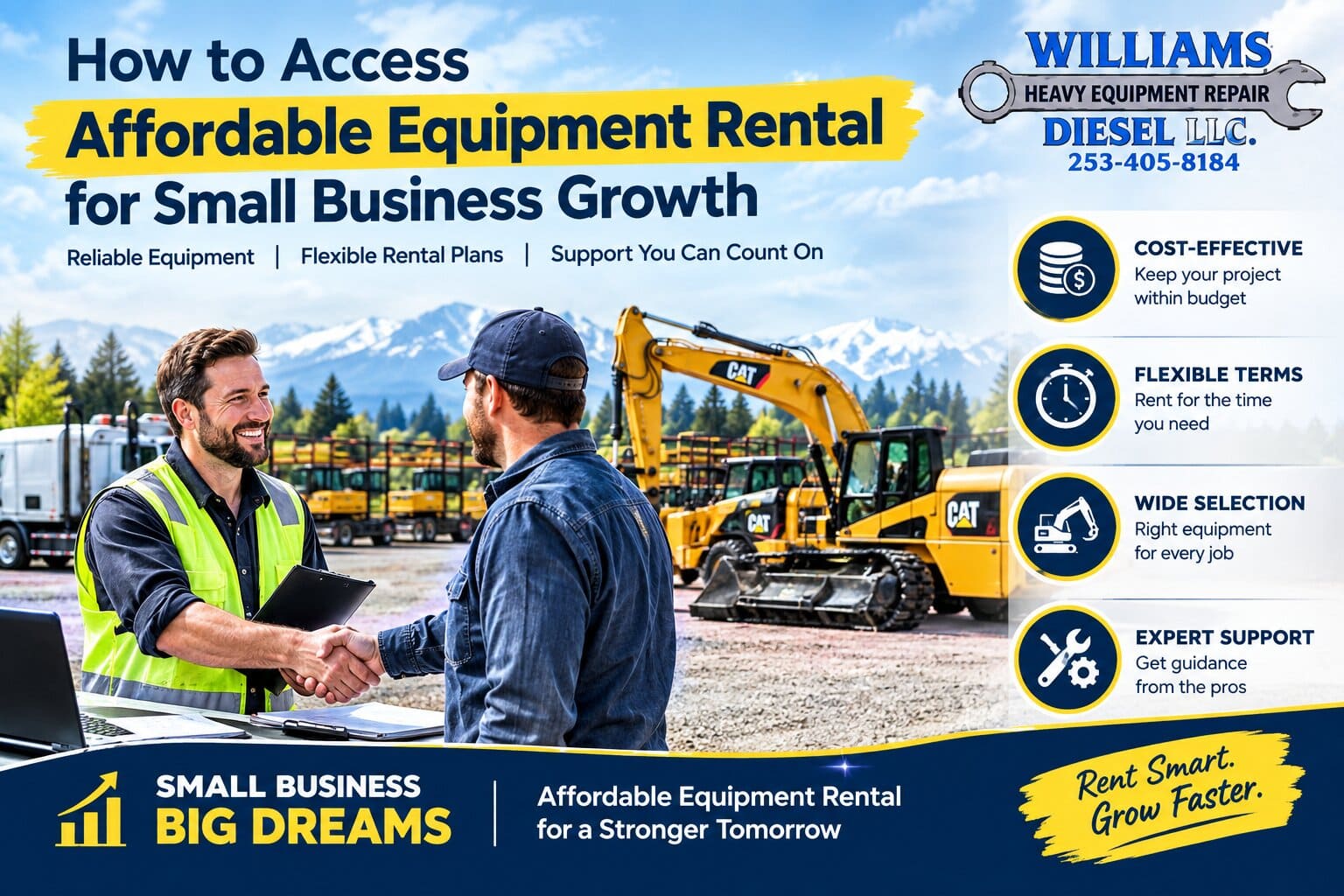
Running a growing trade business, landscape company, or subcontracting firm is an exercise in resource allocation. Every bid you win requires balancing labor, materials, and machinery without exhausting your operating reserves. When specialized earthmoving or heavy support machinery is required, purchasing equipment outright can tie up vital capital in high monthly loan payments, steep depreciation curves, and ongoing shop overhead. That is why so many savvy trade operators rely on an affordable equipment rental strategy to scale their job capacity while keeping debt off their balance sheets. In Eatonville, Washington, and the surrounding Pacific Northwest communities, independent contractors consistently partner with Williams Diesel LLC to secure dependable, job-ready machinery backed by expert diesel support and fair, transparent terms.
Stepping into larger commercial or residential contracts requires access to reliable horsepower. By understanding how the rental lifecycle works, how to vet fleet inventory, and how to avoid hidden line-item markups, small business owners can turn machine rentals into a predictable engine for sustainable growth.
Request A Free Quote Now – Message Us on WhatsApp for rental affordable equipments :
Cash Flow Economics: Why Renting Outperforms Buying for Small Businesses
For a startup or mid-sized subcontractor, cash reserves represent your company’s safety margin. Committing sixty, eighty, or one hundred thousand dollars to buy a single piece of heavy equipment drains working capital that should be reserved for payroll, material deposits, and emergency reserves.
When you purchase heavy machinery, the initial down payment is merely the beginning of your financial commitment. Owners carry full responsibility for monthly financing notes, inland marine insurance, registration fees, secure yard storage, scheduled fluid services, track maintenance, and emergency component repairs. If that machine sits parked for two weeks between jobs, it continues to cost your business money every single day.
Securing an equipment rental for small business operations changes the entire accounting dynamic. When you buy a machine, you take on significant upfront capital drains through down payments ranging between fifteen and twenty-five thousand dollars, coupled with ongoing debt service and full utilization risk during slow winter months. In contrast, choosing a structured rental model limits upfront expense to a basic security deposit and the initial cycle rate. You bill the rental costs directly into your project estimates, and the machine returns to the yard as soon as the project wraps up, eliminating long-term balance sheet liabilities. This on-demand framework allows small businesses to bid on larger, more profitable jobs that would otherwise be out of reach.
Choosing the Right Rental Agreement Structure
Rental suppliers structure contracts across several standardized time horizons. Selecting the correct billing tier directly dictates your profit margins on the jobsite.
Daily rentals are ideal for quick one-off emergency jobs, ditch cleanouts, or brief weekend landscaping installations. While carrying the highest day-rate cost, daily terms offer absolute flexibility when timeline variables are tight.
Weekly rentals represent the standard choice for utility installations, residential foundation digs, or retaining wall construction. Weekly structures generally price out to roughly three or four times the daily rate, effectively giving contractors several free operational days of machine runtime.
Monthly cycles are the most cost-effective tier for commercial builders managing phased site prep. Monthly agreements deliver substantial discounts off standard rack rates, driving down your daily machinery overhead significantly over extended project timelines.
When bidding on institutional or municipal builds, contractors often transition from simple short-term checkouts to formal commercial equipment rental accounts. Establishing an open commercial account with a regional yard unlocks streamlined dispatch scheduling, simplified single-invoice billing, and consistent equipment availability during peak construction months.
Right-Sizing Machinery: Selecting the Best Compact Equipment
A common error made by emerging contractors is choosing either an undersized machine that strains under job requirements or an oversized brute that is impossible to maneuver across confined residential properties. Matching machine metrics to project specifications is vital.
For compact earthmoving, equipment falling into the 1.5-ton to 2.5-ton category offers dig depths between seven and eight and a half feet, making it the premier choice for backyard landscaping and shallow utility lines. Machines in the 3.0-ton to 4.0-ton class reach digging depths between nine and a half and ten and a half feet, serving as the industry workhorse for foundation footings and structural retaining walls. Step up to the 5.0-ton to 6.0-ton range, and you gain digging depths beyond twelve feet, which is necessary for deep municipal sewer mains and high-volume mass earthmoving.
For residential utility cuts, tight property boundaries, and side-yard grading, compact excavators in the 3-ton to 4-ton bracket represent the sweet spot of earthmoving versatility. Reviewing real-world performance metrics, such as the proven cat 303e specs with its tight tail swing, 24-horsepower engine, and dependable 10-foot digging reach, illustrates why compact excavators are a staple for small excavation contractors.
Beyond earthmoving, vertical construction, interior structural finishing, and industrial electrical work demand reliable aerial access. Rather than purchasing specialized aerial lifts that require complex transport rigs and annual ANSI inspections, arranging a scissor lift rental seattle contractors can mobilize on demand ensures personnel work safely at height while keeping project overhead under control.
Navigating Rates, Delivery Logistics, and Equipment Sourcing
Managing the true cost of renting equipment requires looking closely at total line-item costs rather than just headline banner rates. Comparing mini excavator rental rates across regional yards involves evaluating auxiliary hydraulic setup fees, delivery charges, and damage coverage options.
Logistical transport is one of the most critical variables for small operators. Hauling a 7,000-pound to 10,000-pound machine on a tandem-axle bumper-pull trailer requires a properly rated, heavy-duty tow rig equipped with an integrated trailer brake controller. If your company fleet consists of half-ton service trucks, attempting to haul heavy iron creates safety hazards and risks expensive state DOT citations.
Before attempting to transport machinery yourself, confirm whether your business owns an adequately rated three-quarter-ton or one-ton truck paired with a verified equipment trailer. If your tow vehicle meets structural ratings, you can proceed by checking the trailer deck rating, securing rated grade-70 transport chains, and tensioning ratchet binders. If your fleet lacks proper haul capacity, scheduling direct flatbed delivery from the rental yard directly to your jobsite gate is by far the safest and most efficient path.
To eliminate hauling stress and free up your field technicians, sourcing dedicated compact equipment rental Seattle delivery services allows the rental partner to stage the iron directly at your jobsite gate. This keeps your crew focused on layout, staking, and production rather than burning daylight fighting regional highway traffic.
The Essential Pre-Rental Inspection Protocol
Protecting your company’s profit margins requires conducting a rigorous physical walk-around before signing the delivery slip. Documenting preexisting wear ensures your firm is never unfairly charged for preexisting damage when the machine returns to the yard.
Always run through a detailed construction tool rental checklist with the transport driver or yard technician present:
First, inspect hydraulic cylinders and lines by examining cylinder rods for chrome pitting, weeping gland seals, and hydraulic hose chafe marks. Second, evaluate undercarriage and track tension, looking closely for missing rubber track lugs, cut steel cords, loose bottom rollers, and compacted soil packed inside the idler springs. Third, verify quick-coupler locking pins to ensure that manual locking linchpins or hydraulic wedge blocks seat completely inside the attachment ears. Fourth, check fluid levels and air filters by pulling the engine oil dipstick, checking the coolant expansion tank, and verifying the hydraulic sight glass. Fifth, confirm safety alarms and beacon lighting by ensuring travel motion alarms sound clearly, work lights illuminate, and the cab safety shutoff lever works properly.
If you maintain your own mixed utility fleet alongside rental iron, establishing a relationship with an experienced mechanical team like william diesel repair ensures your commercial trucks and support units stay running smoothly without extended shop delays.
Maximizing Attachment Versatility on the Jobsite
The true profitability of a compact machine lies in its auxiliary attachments. Instead of renting multiple dedicated machines, outfitting a single compact excavator or track loader with specialty tooling turns one power unit into a multi-use workhorse.
By partnering with a yard that carries diverse williams equipment rentals, contractors can tailor machine functionality to each distinct phase of a contract:
- Trenching and Tilting Buckets: Switch from an 18-inch ditching bucket for electrical conduit to a 36-inch smooth-edge tilting bucket for finish grading.
- Hydraulic Breakers: Demolish old concrete driveways and foundation footings without bringing dedicated pneumatic compressor crews on site.
- Post-Hole Augers: Drill fence footings, deck piers, and landscaping tree holes in minutes across dense Pacific Northwest soils.
- Hydraulic Thumbs: Transform standard buckets into agile grapple systems for stacking rock retaining walls, moving logs, and loading demolition debris.
Using a single carrier machine outfitted with quick-change attachments saves hours of manual labor, keeps crew sizes lean, and protects your project timeline.
Maintaining Site Efficiency and Fleet Reliability
When working against weather windows and tight completion deadlines, machine reliability is essential. Having an excavator blow an auxiliary hose or throw a track stalls your entire crew, turning a profitable bid into an expensive delay.
This is where finding a truly affordable equipment rental partner matters. The lowest daily rate on paper quickly turns expensive if the machine arrives with worn hydraulic fittings, dirty fuel filters, or weak batteries that fail on a chilly morning. Reputable independent suppliers inspect, grease, and cycle-test every machine between contracts, guaranteeing that the equipment arrives ready to work.
Furthermore, independent yards understand the operational realities faced by small builders. They provide personalized support, flexible extension policies when site conditions change, and responsive field technicians who can troubleshoot issues on site.
Local FAQs: Small Business Equipment Rentals
Q1: What documentation does a small business need to set up an equipment rental account?
To open an equipment rental account, a small business typically needs a valid government-issued photo ID, an active commercial business license, a credit card for the security deposit, and a standard Certificate of Insurance (COI) naming the rental yard as an additional insured and loss payee for rented machinery.
Q2: What are your local dispatch and site delivery response times?
For contractors working throughout Pierce and King Counties, rental deliveries are generally coordinated within 24 hours of account confirmation. Same-day mobilization is frequently available for emergency utility repairs or sudden equipment failures, depending on current yard inventory and lowboy dispatch schedules.
Q3: What specific geographic service areas do you cover in Washington?
Equipment rental and machinery mobilization services cover Western Washington, with primary coverage across Eatonville, Tacoma, Puyallup, Kent, Renton, Seattle, and neighboring rural communities. Machinery can be staged directly at residential jobsites, commercial builds, or civic staging areas.
Q4: What should a contractor do if a rental machine shows a mechanical fault on site?
If a machine shows a warning light, temperature spike, or hydraulic leak, shut down the engine immediately and contact the rental yard dispatch desk. A mobile diesel field technician will be dispatched to evaluate the diagnostic code, replace failed wear items, or swap out the equipment to keep your project running.
Q5: Can small contractors pick up and haul rented machinery with their own trucks?
Yes, provided your hauling rig satisfies federal and Washington State Department of Transportation gross vehicle weight standards. Your truck, trailer, tie-down chains, and transport binders must be rated to safely carry the operating weight of the rented equipment.
Final Thoughts: Fueling Sustainable Business Growth
Scaling a trade business requires discipline, smart capital allocation, and dependable partnerships. Purchasing heavy machinery too early can drain working capital and expose your business to cash flow stress during off-season slowdowns. By relying on a strategic, affordable equipment rental model, you give your company the flexibility to take on diverse, high-value projects while keeping your balance sheet healthy.
Whether you are searching for dependable equipment rental near me to keep a residential site prep project moving forward, sourcing a powerful rent f350 dually near me to mobilize heavy project trailers, or locating a reliable cat excavator rental near me to knock out utility trenches, partnering with an experienced local provider gives your business a distinct competitive edge. For transparent rental agreements, top-tier machinery, and customer-focused diesel support across Eatonville, Washington, and the wider Puget Sound region, rely on the proven professionals at Williams Diesel LLC.

Comments are closed