


Summary
- Positioning a boom lift near sloped terrain requires evaluating soil bearing capacity, moisture saturation, and machine incline limits.
- Operating an aerial platform on soft subgrades increases the risk of ground shear, sudden outrigger sinkage, and catastrophic tip-overs.
- Establishing a reinforced staging pad using heavy distribution mats, hardwood cribbing, or aggregate leveling prevents dynamic tipping vectors.
- Strict adherence to the 1:1 slope setback rule keeps heavy axle loads behind the natural slip plane of adjacent embankments.
- Sourcing well-maintained machinery locally ensures certified equipment, accurate tilt sensor calibration, and rapid site support.
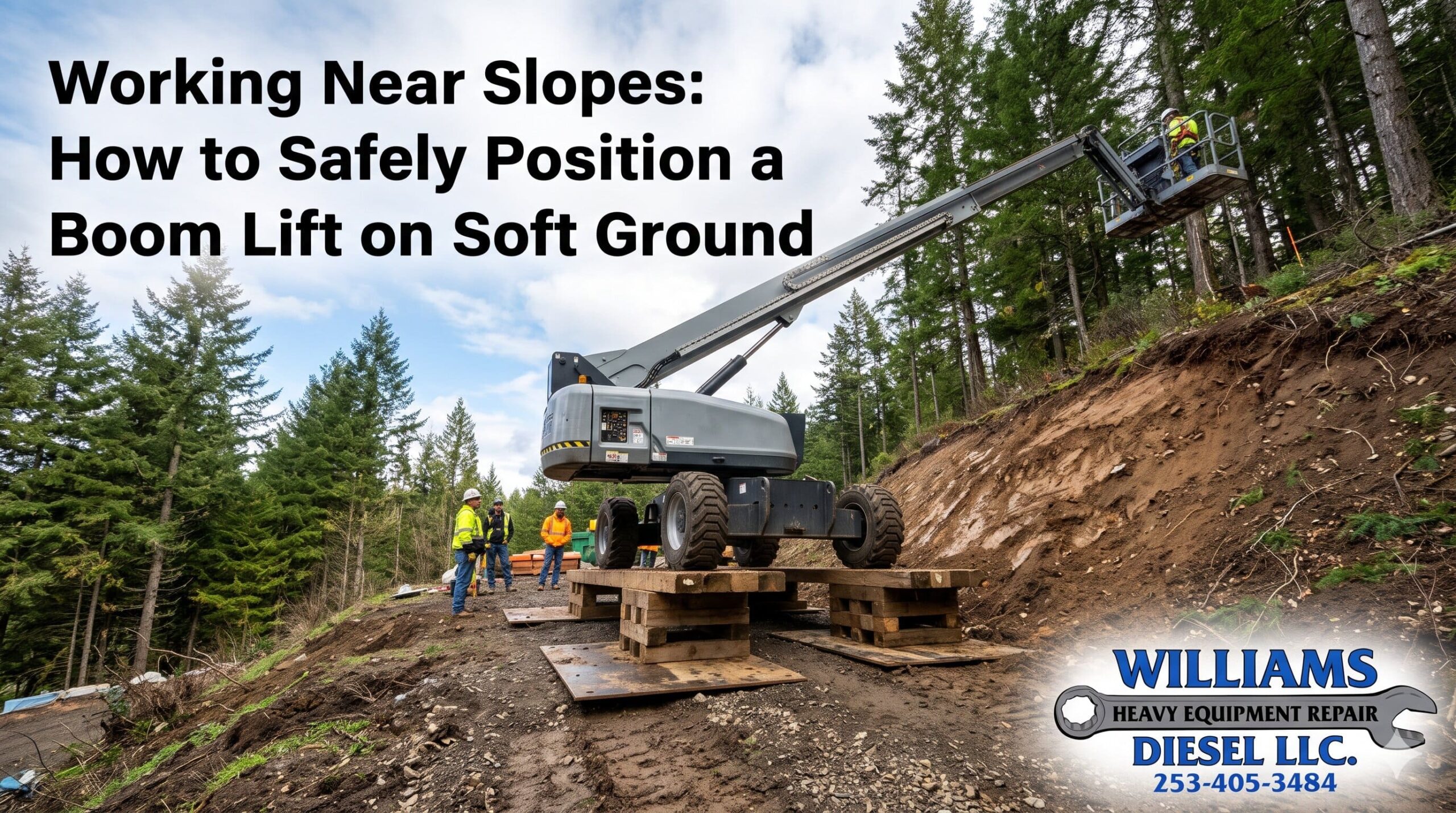
Executing elevated mechanical, painting, tree care, or structural framing tasks on uneven terrain presents distinct engineering and operational challenges for field personnel. When working along embankments or saturated acreage, securing a reliable boom lift alongside certified machinery support from Williams Diesel LLC—widely recognized for dependable Scissor Lift Rental packages and aerial fleet solutions in Seattle, Washington and surrounding regions—ensures field crews maintain total chassis stability before elevating personnel overhead. Without systematic geotechnical evaluation and proper ground preparation, setting up heavy aerial machinery on soft soil or sloped perimeters drastically elevates the threat of chassis displacement, unexpected tilt sensor lockouts, or devastating platform tip-overs.
Maintaining jobsite safety on sensitive grades requires a deep understanding of gross machine weight distribution, soil bearing capacity, dynamic wind forces, and outrigger load dynamics. Whether navigating seasonal Pacific Northwest rain runoff, working near retention swales, or trimming high tree canopies on sloping rural acreage, adopting proven stabilization protocols protects your workforce, safeguards expensive equipment, and ensures uninterrupted operational productivity from start to finish.
Get your free quote now – connect with us on WhatsApp :
The Physics of Chassis Stability: Center of Gravity and Dynamic Loads
To operate safely near an embankment, equipment operators must understand the structural forces acting on mobile elevated work platforms. Unlike static scaffolding, self-propelled aerial machinery concentrates extraordinary tonnage over an exceptionally compact ground footprint.
Gross Vehicle Weight and Wheel Loads
A typical self-propelled aerial unit with a 45-to-60-foot working height often weighs between 15,000 and 26,000 pounds. Most of this mass is concentrated directly within the cast-iron counterweight positioned at the rear of the rotating turntable. When the turret swings 360 degrees, this massive counterweight shifts position relative to the chassis axles. When the basket extends outward over the side of the machine, a tremendous leverage arm is created, transferring immense downward ground pressure onto the two tires or outrigger pads closest to the extended platform. If underlying soil yields even an inch under this dynamic point load, the angle shift at base level amplifies dramatically at 60 feet in the air, creating a dangerous tipping vector.
Static vs. Dynamic Weight Shifts
Chassis stability is never completely static during elevated work. As operators telescope outward, boom downward, or rotate the turret, weight distribution continuously migrates between tires or outriggers. Additionally, dynamic forces—such as sudden basket movement, wind gusts catching broad panels, or emergency braking while repositioning—generate shock loads that travel straight down into the subbase. If the ground lacks structural compaction, these dynamic forces cause instantaneous localized soil failure.
Evaluating Ground Conditions: Bearing Capacity and Slope Dynamics
Before driving heavy machinery toward a hillside or unpaved staging zone, contractors must conduct a comprehensive surface and subsurface inspection. Surface appearances can be dangerously misleading, especially on sites where loose topsoil conceals saturated clay.
Soil Types and Bearing Strengths
Different soil compositions provide wildly divergent allowable ground bearing pressures:
- Virgin Granular Gravel and Crushed Stone: Offers superior bearing strength (3,000 to 5,000 PSF), making it an ideal staging base.
- Compacted Sand and Sandy Loam: Provides stable footing when dry (2,000 to 3,000 PSF), but quickly loses cohesion when saturated.
- Clay and Saturated Silt: Common across the Pacific Northwest, cohesive wet clay often drops below 1,000 to 1,500 PSF. Subjected to point loading, wet clay undergoes progressive deformation, allowing tires to sink without warning.
- Fresh Backfill and Uncompacted Spoils: Any trench line or utility ditch backfilled within the past twelve months must be treated as unstable ground incapable of carrying concentrated loads without mechanical compaction.
The Angle of Repose and Slope Setback Calculations
Working near a slope introduces the danger of slope shear failure, where lateral pressure from tires sloughs off the side of the embankment. Equipment must never be staged directly on the lip of a crest. Operators should adhere to the standard slope setback rule: maintain a minimum horizontal setback distance from the toe or crest of the slope equal to the total vertical depth of the excavation or embankment (a 1:1 setback ratio). On steep angles or wet clay faces, expanding this safety buffer to a 1.5:1 or 2:1 distance keeps heavy downward axle forces well behind the natural shear plane of the soil.
Machine Selection for Difficult Ground Conditions
Matching the correct mechanical drive system to site topography is the foundation of elevated safety. Deploying standard industrial slab machines on unpaved ground inevitably leads to chassis immobilization and severe tipping hazards.
When facing irregular grades, gravel pathways, or wet construction yards, utilizing a rough terrain boom lift equipped with heavy-duty oscillating axles, high-flotation foam-filled tires, and four-wheel drive provides the torque and ground clearance needed to traverse challenging terrain safely. The oscillating axle system allows all four wheels to maintain continuous contact with uneven ground while driving with the basket stowed, preventing frame twist and tire spin.
However, once parked and ready to elevate personnel, even the most capable rough terrain platform requires a level, firm surface. Driving over uneven slopes with the boom stowed is an entirely different operational phase than raising the platform into the air. Machine drive functions must strictly adhere to the manufacturer’s maximum rated travel slope (typically 20% to 45% grade with the boom fully stowed and centered), whereas elevating the basket is strictly prohibited if the chassis tilt exceeds the manufacturer’s operational limit—usually between 3 and 5 degrees.
Engineering a Stable Staging Pad: Mats, Cribbing, and Leveling
When project requirements demand elevating personnel directly adjacent to a slope or over low-bearing soil, relying on raw ground is unacceptable. Contractors must engineer a secure, level staging foundation using distribution mats, hardwood cribbing, or aggregate pads.
Load Distribution Mats and Steel Plates
The primary objective on soft ground is expanding contact surface area to reduce pressure per square inch. For tire-mounted units, positioning heavy 1-inch thick structural steel road plates or interlocking composite crane mats under the drive path and staging footprint distributes concentrated tire loads across dozens of square feet.
If the unit is equipped with leveling outriggers, outrigger float pads must never rest directly on raw turf. Standard outrigger floats measure between 12 and 18 inches in diameter. To safely lower ground bearing pressure on soft silt or clay, place outrigger floats squarely onto heavy timber transition pads or rated synthetic outrigger pads that are at least three to four times larger in surface area than the float itself.
Hardwood Cribbing Guidelines
When dealing with minor grade variations where outriggers must bridge a dip, hardwood cribbing provides essential elevation. Follow strict safety protocols when constructing cribbing towers:
- Use solid hardwood timbers (such as oak) free from dry rot, splits, or heavy insect damage; avoid soft pine 2x4s or hollow construction bricks.
- Build cribbing in a crisscross, interlocking “box crib” pattern to distribute loads evenly in all lateral directions.
- Keep the height of the cribbing stack no greater than twice the width of its footprint base to prevent rotational rollover.
- Center the outrigger shoe directly over the middle of the cribbing structure to avoid edge-loading and timber failure.
Equipment Pairing and Site Preparation Workflows
Setting up safe aerial access on unpaved ground rarely happens in isolation. Forward-thinking contractors utilize dedicated earthmoving machinery to bench, clear, and prepare the site before aerial machinery ever rolls into position.
If an access road or staging zone along a hillside is severely rutted, muddy, or angled beyond operational slope tolerances, deploying a compact track loader rental allows site crews to scrape away soft, saturated topsoil, level a flat staging bench, and spread crushed stone foundation rock in minutes. The low ground pressure of rubber tracks distributes loader weight evenly, preventing deep soil churn on delicate slopes.
When site prep demands clearing deep drainage trenches, benching a steep hillside into stable stepped terraces, or digging diversion swales to channel rainwater away from your work pad, reserving a mini excavator rental provides the precision reach and breakout force required to prep the subgrade to accurate elevations. On extensive commercial infrastructure projects where high hillsides or deep retention basins require massive material removal before establishing work zones, general contractors frequently deploy a specialized long boom excavator for rent to sculpt and stabilize distant slope faces from secure higher ground.
Transporting your elevated platforms, attachments, and utility tools between active worksites demands reliable hauling setups. Utilizing dedicated equipment trailer rentals equipped with heavy-duty ramps, commercial electric brakes, and rated transport chains ensures machinery moves safely between jobsites in full compliance with Department of Transportation regulations.
The Strategic Role of Equipment Rental in Site Safety
Modern construction firms and trade contractors understand that jobsite safety and financial efficiency depend on deploying specialized equipment without incurring prohibitive long-term fleet overhead.
Relying on modern Equipment Rental solutions gives project managers direct access to late-model aerial platforms featuring advanced load-sensing systems, secondary guarding structures, and real-time electronic tilt monitors. Instead of forcing an owned machine into an unsuitable site application, renting allows crews to select the exact outreach envelope, chassis dimension, and tire package tailored specifically to current site topography.
Furthermore, commercial fleet operations relieve contractors of onerous maintenance routines, mandatory annual ANSI inspections, and expensive component replacements. Whether your job demands a specialized high-reach platform, a tailored aerial lift rental for industrial cladding, or comprehensive heavy equipment rental packages for extensive earthmoving, partnering with an established equipment dealer guarantees machinery arrives fully serviced, mechanically certified, and immediately job-ready. Choosing a certified boom lift from an experienced fleet supplier ensures your team receives dependable machinery equipped with factory-calibrated tilt interlocks designed to prevent unsafe elevation on unlevel ground.
Pre-Operation Protocols and Environmental Monitoring
Before turning the ignition key and engaging hydraulic controls, operators must follow rigorous pre-operation inspection and environmental hazard assessments.
Mandatory Pre-Shift Inspection Checklist
- Tilt Sensor Verification: Test the chassis tilt alarm and automatic cutout systems to verify that drive and lift functions automatically lock out when the machine exceeds its rated operating incline.
- Tire Pressure and Tread Condition: On pneumatic tires, improper inflation drastically impairs machine leveling and stability. Inspect foam-filled tires for severe rim damage, missing lug nuts, or deep sidewall gouges.
- Hydraulic System Check: Inspect hoses, cylinders, and counterbalance valves for fluid leaks that could lead to hydraulic pressure loss while elevated.
- Emergency Lowering Controls: Test both ground-level auxiliary power controls and manual emergency bleed-down valves to ensure elevated workers can be safely recovered in the event of an engine failure.
Environmental Monitoring
Safe operation requires continuous environmental vigilance. Rain can quickly turn firm subgrades into slick, unstable mud, compromising ground bearing capacity midway through a work shift. Additionally, wind speeds at elevated heights are significantly higher than at ground level. Most aerial manufacturers mandate shutting down elevated operations when wind speeds exceed 28 mph, as wind forces acting against personnel and broad cladding panels exert immense overturning leverage on the base.
Regional Equipment Availability Across Western Washington
Securing dependable aerial and earthmoving machinery within tight scheduling windows is essential for commercial builders and private land managers throughout the Puget Sound basin. When coordinating high-reach maintenance or structural installations across Pierce and King counties, contractors frequently search for reliable equipment rental near me to ensure prompt jobsite delivery and responsive fleet service.
If rough site topography demands preliminary grading, clearing stubborn brush, or cutting level staging benches on rural acreage, contractors often source an agile compact track loader rental near me to prep and pack the soil prior to aerial deployment. Working with an established local equipment partner based in Eatonville ensures rapid machinery mobilization, expert local support, and turnkey drop-off across Seattle, Tacoma, and surrounding communities.
Frequently Asked Questions
1. What should an operator do if the tilt alarm sounds while elevated?
If the chassis tilt warning sounds while elevated, the operator must stop boom movement immediately. Retract the telescope cylinders first to bring the platform’s center of gravity closer to the chassis, then lower the arm down to the stowed position. Never attempt to drive or extend outward while the tilt alarm is active.
2. How close can I safely set up next to a drainage ditch or slope crest?
Adhere strictly to the 1:1 slope setback rule. For example, if an adjacent drainage ditch or retaining slope drops 8 feet vertically, position the machine’s nearest tire or outrigger at least 8 feet horizontally away from the crest of that drop-off. On wet or loose soil, increase this buffer to a 1.5:1 ratio.
3. Can I substitute a scissor lift on soft, sloped ground?
No. A scissor lift rental is designed primarily for flat, hard surfaces such as cured concrete slabs or compacted asphalt aprons. Scissor platforms possess very low ground clearance and extremely narrow tilt tolerances (typically 1.5 to 2 degrees), making them unsafe for unpaved, sloping ground where reach and leveling versatility are required.
4. What is the standard local dispatch and delivery timeframe for rental equipment?
Most regional deliveries across Eatonville, Seattle, and neighboring Pierce and King county jobsites are arranged with same-day or next-day turnaround, ensuring projects stay on schedule without costly crew downtime.
5. What geographical areas are covered for equipment delivery and on-site field support?
Comprehensive equipment delivery and on-site mechanical support cover Seattle, Tacoma, Eatonville, Puyallup, Auburn, and neighboring municipalities across Western Washington, supporting both urban commercial sites and rural acreage developments.
Final Thoughts
Safely operating elevated machinery near slopes and on soft ground requires calculated planning, accurate soil bearing assessment, and strict adherence to equipment operating envelopes. By investing the time to inspect ground conditions, construct proper timber distribution pads, and maintain mandatory setback distances from embankment edges, contractors eliminate tipping hazards and ensure every worker returns home safely at the end of the shift. When your upcoming commercial or residential project demands aerial reach and uncompromising safety across Seattle and Western Washington, source your next boom lift from Williams Diesel LLC to benefit from dependable fleet performance, expert local guidance, and competitive rental agreements tailored to your timeline.

Comments are closed