


Summary
- Selecting the right plate compactor rental is essential for achieving proper aggregate density under driveways, patios, and walkways.
- Granular materials like crushed gravel and bedding sand require high-frequency vibration rather than heavy static weight to settle.
- Matching centrifugal force to lift depth prevents aggregate bridging and eliminates underground voids that cause premature settling.
- Planning machine workflows alongside loaders, excavators, and haulers speeds up subgrade clearing and bulk gravel spreading.
- Sourcing well-maintained machinery locally ensures reliable performance, clear rental terms, and fast jobsite mobilization.
Every durable patio, driveway, sidewalk, or structural foundation begins with what lies beneath the surface. When laying down aggregate foundations, securing a dependable plate compactor rental from a trusted regional provider like Williams Diesel LLC ensures your project in Seattle, Washington and neighboring communities achieves the structural density required to eliminate long-term settling, shifting, and water pooling. Without proper mechanical consolidation, loose aggregate particles will gradually compress under vehicle traffic or seasonal moisture changes, leaving behind cracked slabs, sunken paving stones, and expensive remedial repairs.
Navigating base preparation requires understanding how different aggregates behave under vibration, how machine sizes influence consolidation depth, and how to operate equipment efficiently across varying site layouts. Whether leveling a residential gravel driveway or preparing bedding sand for commercial flatwork, choosing the correct machine configuration makes all the difference in achieving a flat, long-lasting finished grade.
Get in touch on WhatsApp and request your free quote :
The Science of Subbase Preparation: Gravel vs. Sand
Soil and aggregate mechanics dictate how ground reacts under mechanical vibration. Soils fall broadly into two primary categories: cohesive soils, such as sticky clay or dense silt, and granular materials, such as crushed stone, quarry process rock, and coarse bedding sand.
Granular aggregates do not bond chemically or stick together through natural cohesion. Instead, their load-bearing capacity relies entirely on mechanical interlock and friction between individual particle faces. When crushed rock or sand is dumped from a truck bed, individual pieces sit loosely with significant air pockets trapped throughout the matrix. Applying a heavy static roller will often push loose sand forward rather than compress it downwards.
To consolidate granular aggregates, high-frequency vibratory energy must travel through the material. Rapid vibration temporarily breaks the surface friction between adjacent gravel pieces, allowing gravity and downward force to pull smaller particles into the microscopic voids between larger stones. This interlocking action transforms loose, unstable aggregate into a solid foundation capable of carrying substantial wheel loads.
Machine Selection: Forward vs. Reversible Plate Units
Plate equipment is categorized by directional mobility, operating weight, plate footprint, and centrifugal force. Selecting the ideal unit depends on whether you are working in wide-open expanses or confined trenches.
Single-Direction (Forward) Plate Units
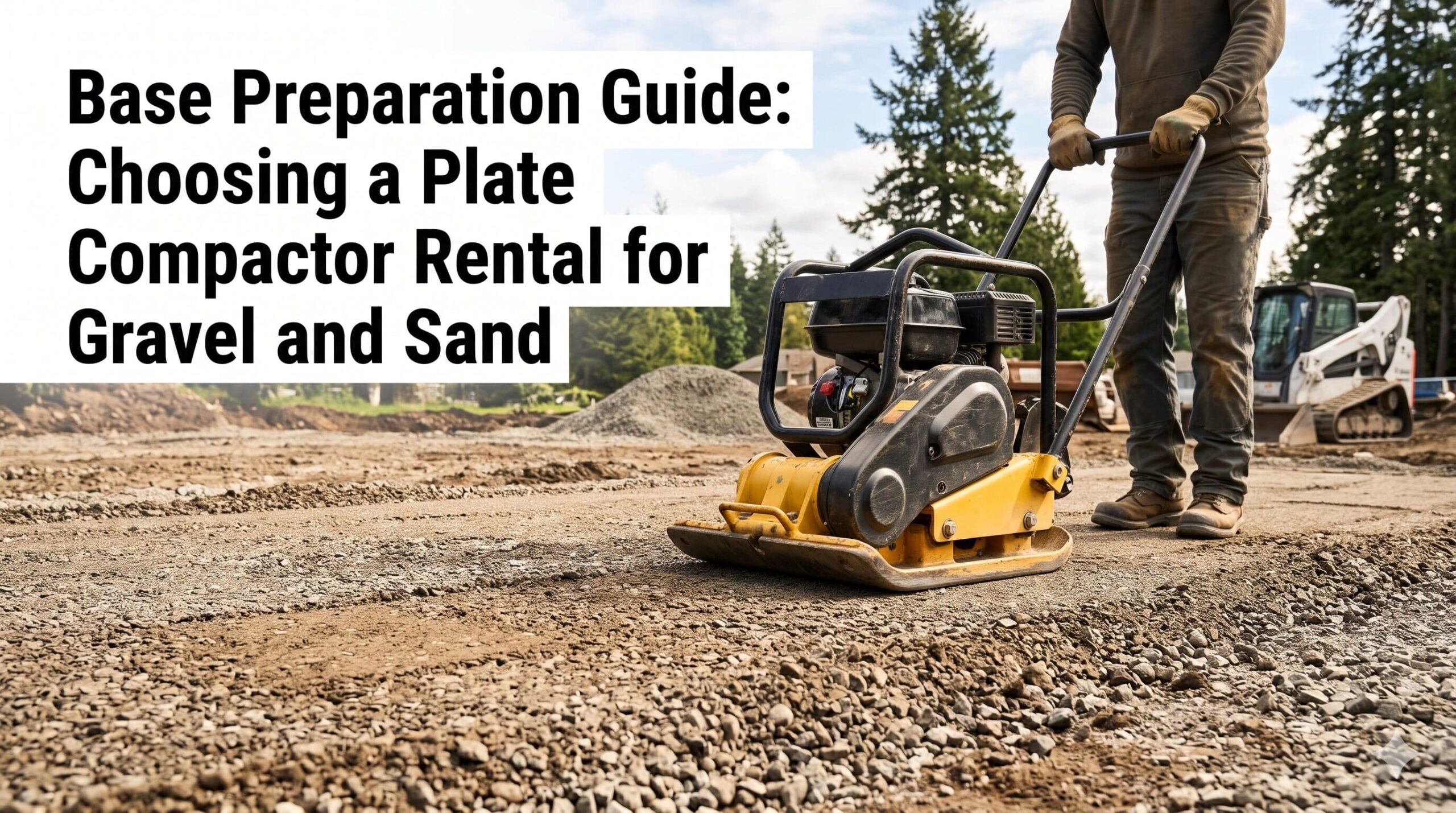
Single-direction units are the standard choice for residential landscaping, walkway construction, and asphalt patching. Ranging in operating weight from roughly 130 to 220 pounds, these compact units generate between 2,000 and 3,500 pounds of centrifugal force.
Their mechanical design features an eccentric exciter shaft mounted toward the front edge of the baseplate, pulling the unit forward at a steady walking pace while transmitting vertical vibrations directly into the soil. Because forward units cannot reverse mechanically, the operator steers them in continuous forward loops. They are lightweight enough for two workers to lift manually into a truck bed or roll along on detachable transport wheels, making them ideal for residential side yards, tight patio corners, and base prep under pavers.
Reversible Plate Units
When earthmoving requirements demand deeper lift depths, greater impact force, and precision handling along structural walls, reversible units become essential. Weighing between 350 and over 1,000 pounds, these heavy units utilize dual counter-rotating eccentric weights.
By shifting a mechanical or hydraulic control lever on the guide handle, the operator can transition seamlessly from forward travel to reverse or hold the unit stationary over stubborn high spots. This maneuverability makes reversible units indispensable for narrow drainage trenches, foundation backfills, and deep utility runs where turning around is physically impossible. Furthermore, their massive centrifugal output allows contractors to consolidate thick gravel layers up to 16 to 24 inches in a single pass.
Centrifugal Force, Vibratory Frequency, and Lift Thickness
To avoid jobsite failures, contractors must match the machine’s centrifugal force and operating frequency to the depth of the aggregate layer, known within the industry as the lift thickness.
Centrifugal Force
Centrifugal force determines how deeply vibratory shockwaves penetrate through the material. A small 2,500-pound force unit will effectively pack a 4-inch layer of crushed rock, but if you spread 10 inches of gravel in one go, vibrations dissipate before reaching the bottom. The top 3 inches will feel firm, but the bottom 7 inches remain loose and uncompacted, causing settling later under heavy loads. Always spread aggregate in shallow lifts—typically 4 to 6 inches for forward machines and up to 10 to 12 inches for mid-sized reversible units—packing each layer thoroughly before adding the next.
Vibratory Frequency
Measured in Vibrations Per Minute (VPM), frequency defines how fast the baseplate oscillates against the ground. For granular materials like sand and fine gravel, higher frequencies (typically 5,000 to 6,000 VPM) are optimal because small particles respond best to rapid agitation. Conversely, heavier cohesive soils require lower frequencies paired with higher amplitude strokes to shatter clay bonds.
Step-by-Step Base Preparation for Patios and Driveways
Executing a flawless aggregate base requires a disciplined, step-by-step methodology from rough subgrade excavation to final bedding screed.
1. Subgrade Excavation and Soil Stabilization
Before adding a single shovel of crushed aggregate, the native subgrade soil must be excavated down to virgin ground. Strip away all organic topsoil and roots, as organic matter will rot over time and create underground voids. Once native clay or dirt subgrade is exposed, run your plate unit over the raw ground to verify that no soft pockets remain. In areas with high moisture, rolling out a non-woven geotextile stabilization fabric over the subsoil prevents crushed gravel from sinking into the mud over time.
2. Sourcing and Placing Base Aggregate
Select an angular, crushed aggregate that includes a blend of stone sizes down to fine rock dust. Standard 5/8-inch minus or 3/4-inch minus crushed rock is ideal because sharp edges lock together under vibration, while fine stone dust acts as an aggregate mortar. Dump and spread the material evenly, maintaining an even thickness of no more than 4 inches per layer.
3. Moisture Management
Moisture acts as a natural lubricant that helps gravel and sand slide into tight formations. If aggregate is bone dry, friction keeps particles apart, causing the machine to kick up dust without achieving true density. If material is soaking wet, water fills internal voids and creates hydrostatic pressure, making the ground squishy. Perform a simple hand test: squeeze a handful of crushed rock tightly into a ball. If it crumbles into loose dust, mist the area lightly with water. If water squeezes out between your fingers, let it air out. If it holds its shape cleanly, moisture content is near optimum.
4. Grid Patterns and Pass Overlaps
Operate the machine in a deliberate, organized grid pattern. Begin at the outer perimeter of the project area, running along edges and working inward toward the center in parallel straight passes. Always overlap each subsequent pass by roughly 4 to 6 inches to ensure no uncompacted seams remain. A properly prepared aggregate base generally requires three to four complete passes per lift. You will know maximum density has been reached when the machine changes its acoustic pitch, begins bouncing noticeably on the rock surface, and leaves no visible indentations in its wake.
Equipment Pairing and Jobsite Fleet Workflows
Base preparation rarely exists in total isolation. On large residential acreage or commercial grading sites, earthmoving and base installation involve multiple pieces of machinery working in close harmony.
Before compaction begins, moving multiple cubic yards of dense crushed base rock across a property requires efficient haulage. Deploying a compact track loader rental allows operators to rapidly transfer bulk gravel piles from delivery staging zones straight to the excavation footprint without rutting damp lawns or soft subsoils. For initial excavation, digging out foundation trenches, removing stubborn tree stumps, and cutting backfill trenches, booking a mini excavator rental provides the precision reach and breakout force required to prep the subgrade to accurate elevations.
Transporting your gear, attachments, and utility tools between active worksites demands reliable hauling setups. Utilizing dedicated equipment trailer rentals equipped with heavy-duty ramps, commercial electric brakes, and rated transport chains ensures machinery moves safely between jobsites in full compliance with Department of Transportation regulations.
Evaluating Rates, Budgeting, and Sourcing Options
Managing jobsite costs requires maintaining a transparent overview of operating expenses. Securing competitive equipment rental rates allows contractors and independent property owners to bid accurately on multi-phase flatwork contracts without unexpected cost overruns.
When structuring project budgets, determining the total duration of your plate compactor rental depends on weather windows, delivery logistics, and overall square footage. Daily rates are tailored for rapid single-day patio builds or weekend trench backfilling, while weekly and monthly contracts provide substantial percentage discounts for larger residential developments. Furthermore, choosing a specialized vibratory plate compactor equipped with optional integrated water tanks allows contractors to transition smoothly from gravel base prep to hot-mix asphalt patching without booking a separate machine.
Beyond short-term savings, working with an established provider known for comprehensive williams equipment rental packages gives builders immediate access to modern machinery that meets clean emissions standards and delivers exceptional fuel efficiency across long operating shifts.
Strategic Advantages of Machinery Rental Over Fleet Ownership
Modern construction and landscape contracting demand exceptional agility. Purchasing commercial-grade machinery ties up critical working capital in bank loans, asset depreciation, secure yard storage fees, and constant shop overhead.
Embracing flexible Equipment Rental solutions empowers contractors to select the exact weight class, hydraulic configuration, and plate dimension needed for each individual contract. You never have to settle for an undersized machine on a massive commercial parking pad or struggle with an oversized unit inside a fenced suburban yard.
Furthermore, routine maintenance schedules—such as checking engine oil levels, replacing air filters, adjusting drive belts, and cleaning exciter housings—are handled directly by factory-trained technicians before the machine ever leaves the yard. If your broader project requires extensive civil site work, integrating a heavy equipment rental or sourcing specialty earthmoving gear from williams machinery ensures your entire fleet operates at peak productivity without the long-term liabilities of asset ownership.
Essential Operator Safety and Pre-Operation Checks
Operating high-frequency vibratory machinery requires diligent adherence to personal safety protocols and daily mechanical inspections.
Personal Protective Equipment (PPE)
Always wear high-grade hearing protection, as small gas engines paired with vibrating steel plates on crushed rock regularly exceed 95 to 105 decibels. Safety glasses and dust masks prevent flying stone chips and airborne aggregate dust from causing injury. Heavy leather work boots with reinforced steel toes protect against accidental baseplate impact, while gel-padded antivibration gloves minimize the risk of hand-arm vibration strain during long shifts.
The 5-Minute Daily Pre-Shift Walkaround
Before firing up the engine, run through this quick operational checklist: check engine oil and top off with clean fuel; inspect the air filter canister to ensure fine aggregate dust has not clogged the paper element; check drive belt tension between the centrifugal clutch and exciter pulley; inspect rubber shock mounts connecting the baseplate to the engine deck; and verify that the steel baseplate is free from caked-on asphalt, hardened concrete, or deep gouges that could mark finished paving surfaces.
Regional Equipment Availability Across Western Washington
Finding well-maintained earthmoving and base stabilization machinery close to your jobsite is critical for maintaining rigid project deadlines. When managing site preparation across rural acreage or suburban subdivisions, contractors frequently need comprehensive soil compaction equipment packages that go beyond a standard walk-behind compactor.
For projects requiring deep drainage excavation, foundation leveling, and utility trenching, contractors in Pierce and King counties often source a large excavator rental near me to handle primary earthmoving before finishing subbases with walk-behind plate machinery. Whether you are searching for an agile equipment rental near me to tackle residential flatwork in Eatonville or coordinating delivery for a large commercial build in Seattle, partnering with a responsive local fleet eliminates extended highway mobilization delays and guarantees machinery that performs on demand.
Frequently Asked Questions
1. How many passes are necessary to achieve proper density on crushed gravel?
Most aggregate bases reach peak density within three to four slow, overlapping passes per lift. Making more than five or six passes often yields diminishing returns and can begin pulverizing surface aggregate into weak dust rather than compacting it.
2. Can I use a plate machine directly on clay or muddy soil?
Plate machines are engineered primarily for granular materials like sand and gravel. On wet clay or cohesive soil, flat plates tend to stick to the mud and lack the amplitude needed to break clay bonds. A trench rammer is better suited for cohesive clay.
3. What is the typical local response time for equipment delivery across Seattle and surrounding areas?
Most standard equipment deliveries are scheduled with same-day or next-day turnaround depending on fleet availability. Rental fleets dispatch directly to your residential address, commercial laydown yard, or jobsite staging area.
4. Which geographic areas receive rental service coverage?
Comprehensive equipment coverage spans Eatonville, Seattle, Tacoma, Puyallup, and surrounding communities throughout Pierce and King counties, supporting residential homeowners, agricultural acreage, and commercial contractors.
5. Do I need to clean the baseplate before returning the equipment?
Yes. Taking a few minutes to hose down the baseplate and remove aggregate dust, caked dirt, or sticky asphalt prevents cleaning surcharges and ensures the machine remains ready for immediate dispatch.
Final Thoughts
A flawless patio, driveway, or foundation slab is only as dependable as the base preparation beneath it. By evaluating aggregate grain sizes, managing moisture content, and selecting the correct centrifugal force for your lift depths, you guarantee an unyielding foundation that withstands the elements for decades. For dependable machinery, transparent terms, and responsive customer service across Seattle and surrounding regions, reserve your next plate compactor rental through Williams Diesel LLC to lay a rock-solid groundwork on your next project.


Comments are closed