


Summary
- Discover why calling an on-site semi truck roadside service eliminates the extreme expense of heavy wrecker towing.
- Identify the most common mechanical trigger points behind commercial rig disablements on high-traffic freight corridors.
- Learn practical diagnostic steps for resolving compromised pneumatic systems, glad-hand air leaks, and sudden trailer spring brake lockups.
- Understand how electronic engine derates, turbo boost leaks, and cooling system failures can be troubleshot directly on the highway shoulder.
- Review safety protocols for securing your disabled tractor-trailer safely while waiting for an emergency mobile technician to arrive.
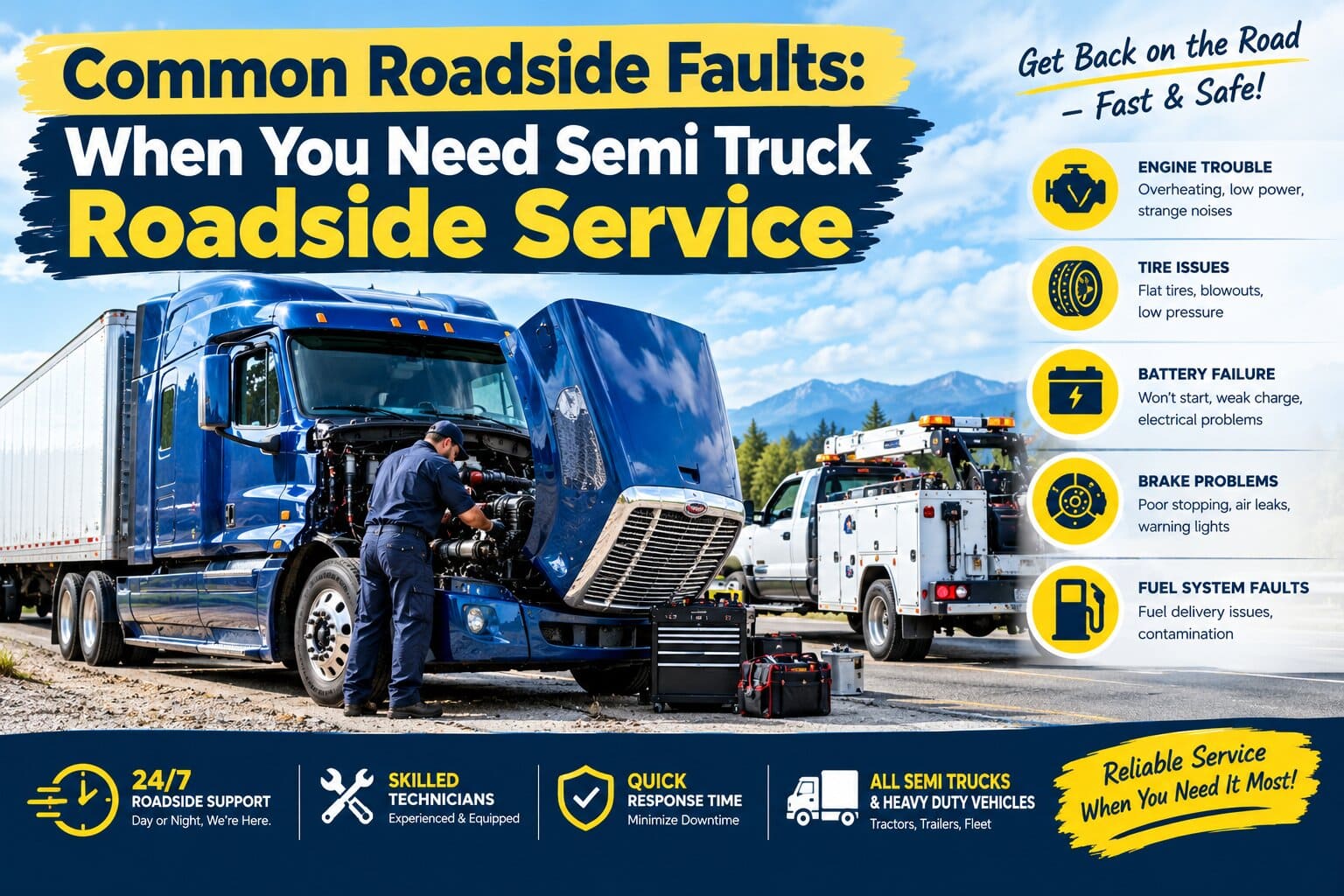
Hauling freight across the Pacific Northwest is demanding on both the driver and the machine. Long mountain grades, stop-and-go maritime corridor traffic, and severe seasonal weather test every mechanical system on a commercial Class 8 rig. When warning lamps flash across your dashboard or an air line ruptures on an interstate shoulder, every passing minute costs your business money, jeopardizes strict delivery schedules, and creates safety hazards.
Instead of instantly ordering a tow truck to drag your loaded combination to an overcrowded dealership lot, calling a dependable semi truck roadside service provides immediate, professional repair right where the truck sits. Across Seattle, Washington, and the broader Puget Sound region, fleet managers and independent drivers rely on Williams Diesel LLC to deliver prompt, cost-effective roadside diagnostics and mechanical repairs that get heavy commercial haulers moving forward safely.
Navigating an unexpected highway failure requires understanding what causes these disablements, what can be fixed on the shoulder, and how fast mobile interventions keep operating costs from spiraling out of control.
Need immediate roadside help or a quick repair quote? Message our team on WhatsApp now:
The True Cost of Unexpected Highway Disablements
When a commercial rig stops moving, the operational clock starts ticking against your operating margins. A typical commercial truck breakdown does far more than just delay a single load. It ripples throughout your entire dispatch network, triggering missed delivery appointments, detention fees from waiting distribution warehouses, and potential penalties from high-value freight brokers.
Beyond immediate freight delays, towing a disabled commercial combination is one of the most expensive emergency expenses in transportation. Heavy wreckers bill substantial hook fees, steep per-mile rates, and additional labor charges to drop drivelines or disconnect axle shafts before the truck can roll. Once towed to a metropolitan franchise dealership, your truck frequently sits in an intake yard for days behind pre-scheduled fleet service appointments.
This reality has led owner-operators and fleet superintendents to look closely at practical heavy-duty towing alternatives. Having a fully equipped mobile repair truck arrive on site eliminates the need to haul the vehicle off the road. An experienced technician diagnoses the root problem on the shoulder, installs replacement components, clears the fault codes, and sends the driver on their way in hours rather than days.
Critical Air System Failures and Brake Lockups
Pneumatic systems are the lifeblood of commercial transportation, responsible for operating foundation brakes, air suspension bags, cab mounts, and transmission splitters. Because federal motor carrier safety regulations require spring-applied parking chambers to mechanically lock when system pressure drops below safety thresholds, even a small pneumatic leak will freeze an 80,000-pound combination in its tracks.
A large portion of roadside callouts involve semi truck air brake repair. Constant vibration and road grime degrade rubber hoses, causing them to chafe against chassis rails until they burst. Glad-hand rubber grommets dry out, crack, and leak air at the trailer interface, preventing the tractor from charging the trailer reservoir. Air dryer purge valves can stick open due to oil contamination from an aging compressor, venting all stored reservoir pressure into the atmosphere.
When spring brakes lock up on the interstate shoulder, inexperienced drivers often panic or attempt to force the rig forward, destroying tires and wheel ends. A mobile technician resolves these failures quickly. Technicians carry commercial fittings, push-to-connect brass couplings, standard airline spools, replacement governor valves, and heavy-duty caging bolts. By manually caging frozen chambers safely or replacing blown supply lines on site, the technician restores pneumatic integrity without requiring a heavy wrecker.
Electrical, Starting, and Charging System Breakdowns
Modern commercial diesel engines depend entirely on clean, stable voltage to power multiple electronic control modules, injector solenoids, and exhaust aftertreatment sensors. A slight voltage drop can confuse multiplexed wiring architectures, throwing severe fault codes and shutting down the powerplant completely.
Starting and charging system failures rank among the most common roadside headaches:
First, heavy-duty battery banks often suffer internal cell shorts or post corrosion. A four-battery bank with a single failing cell will drag down the entire system, preventing the starter from turning over the heavy compression of a fifteen-liter diesel engine.
Second, high-output alternators face extreme thermal stress, especially when powering sleeper amenities, auxiliary cooling fans, and complex lighting circuits. When an internal diode fails, the alternator ceases charging the bank, draining the batteries while rolling until the engine management computer shuts down fuel delivery.
Third, primary starter solenoids take a beating from road salt, moisture, and extreme heat cycles. Corroded ground straps and loose battery connections mimic starter motor failure, creating a no-crank condition at weigh stations or rest stops.
Deploying a qualified roadside diesel mechanic eliminates guesswork. Technicians carry high-output carbon-pile load testers, digital multimeters, replacement battery banks, high-torque starters, and heavy-duty jumper systems to restore full electrical power on site.
Fuel System Complications and Winter Gelling
Fuel delivery issues can bring even the newest commercial rig to a dead halt. Because commercial high-pressure common rail fuel systems operate at pressures exceeding thirty thousand pounds per square inch, any restriction in the supply circuit triggers an immediate drop in rail pressure and causes the engine control module to shut the injectors down.
During colder months across the Pacific Northwest, unconditioned ultra-low sulfur diesel fuel begins to form paraffin wax crystals. These wax crystals quickly blind primary fuel filters and water separators, starving the engine of fuel. Even in mild temperatures, algae contamination in fuel tanks, failing low-pressure lift pumps, and compromised fuel suction lines that draw air bubbles into the system will simulate major mechanical failure.
A dedicated heavy duty mobile mechanic arrives with diagnostic fuel pressure gauges, fresh primary and secondary filter elements, and direct fuel system priming pumps. By replacing clogged filters, priming the supply lines, and verifying lift pump delivery pressure, a technician can resolve complex fuel starvation issues right on the highway shoulder.
Cooling System Failures and Thermal Derates
A sudden spike in coolant temperature forces engine computers into protective derate modes, cutting horsepower by fifty percent or initiating an automatic thirty-second shutdown to prevent cylinder head warpage and catastrophic engine seizure.
Cooling failures usually stem from accessible, external wear components:
Ruptured silicone radiator hoses or blown heater core lines dump gallons of coolant onto the roadway in seconds. Charge-air cooler boots crack under high turbo boost pressure, venting intake air and causing severe black smoke, high exhaust gas temperatures, and a total loss of pulling power. Fan clutches can fail to engage, preventing airflow through the radiator pack during long climbs, while water pump weep seals give out under persistent belt tension.
When these thermal emergencies occur, dispatching a mobile service truck allows technicians to perform pressure tests, replace split boots or cracked lines, install heavy-duty constant-torque clamps, and refill the engine with fresh, pre-mixed commercial coolant to get the vehicle safely back into operating temperature parameters.
Equipment Rental and Vocational Fleet Demands
In urban and suburban construction corridors, commercial trucking is deeply intertwined with civil engineering, site prep, and heavy earthmoving projects. Dump truck fleets, equipment haulers, and aggregate transfer rigs operate continuously under rigorous conditions, often moving between tight urban staging lots and rough utility excavations.
In this fast-paced heavy industrial sector, Equipment Rental plays a fundamental role. When project schedules tighten or primary excavation machinery requires scheduled component maintenance, renting compact excavators, track loaders, or heavy hauling support units ensures project deadlines remain intact without requiring massive capital outlay.
When vocational haulers or heavy equipment support trucks break down during an active material drop, project delays multiply quickly. Having an experienced service team capable of troubleshooting both commercial freight trucks and heavy equipment powerplants ensures your transport rigs and rental machinery work seamlessly without stalling your active jobsite.
Diagnostic Software and Electronic Derate Resolution
Few things frustrate a commercial driver more than seeing an amber check engine light turn into a solid red stop-engine warning, followed by a dramatic drop in speed to five miles per hour. Today’s commercial diesel powerplants rely on intricate exhaust aftertreatment systems, including diesel particulate filters, selective catalytic reduction catalysts, and diesel exhaust fluid dosing systems.
When an exhaust temperature sensor, soot level sensor, or DEF doser valve fails, the engine management system initiates a mandatory torque derate to remain within emissions regulations. Many drivers assume these electronic derates require a trip to a dealership, but that is rarely the case.
Equipped with factory-level diagnostic laptops, an experienced technician providing seattle mobile truck repair connects directly to the vehicle’s diagnostic port on site. The technician can read live data streams, test individual component responses, replace failed nitrogen oxide sensors or exhaust gas temperature probes, and initiate a forced stationary regeneration. This comprehensive electronic troubleshooting clears derates immediately, allowing your driver to resume their route without dealer intervention.
Roadside Emergency Action Protocol:
Step 1: Maneuver the combination as far onto the right shoulder or exit ramp as possible.
Step 2: Activate four-way hazard flashers immediately to alert approaching traffic.
Step 3: Set tractor and trailer parking brakes and shut down the engine.
Step 4: Don high-visibility vest and place emergency reflective triangles within ten minutes.
Step 5: Call dispatch and coordinate certified mobile roadside repair.
Navigating Puget Sound Freight Routes and Sourcing Local Mechanics
The transportation corridors around the Puget Sound represent some of the most economically vital, yet heavily congested, freight routes in the country. From the container terminals at the Port of Seattle and Port of Tacoma along Interstate 5, to the heavy distribution centers lining State Route 167 and Interstate 90, traffic volume leaves very little room for mechanical delays.
A disabled tractor-trailer blocking a lane or stalled on a narrow shoulder creates immediate traffic congestion and increases the risk of secondary collisions. Securing rapid, reliable truck repair seattle wa guarantees that mechanical help is deployed quickly, minimizing your vehicle’s exposure to highway hazards.
Furthermore, working with an experienced mobile diesel mechanic Seattle transport companies trust means your technician understands the regional terrain, maritime weather conditions, and high-density warehouse hubs, ensuring they arrive fully prepared with the exact parts and tools required for your specific equipment class.
Local FAQs: Semi Truck Roadside Service
Q1: What specific geographical areas and highway corridors do your mobile units cover?
Mobile roadside service units cover major freight routes and commercial hubs across Western Washington. Core coverage includes the Interstate 5 corridor, State Route 167, Highway 512, and Interstate 90, servicing Seattle, Tacoma, Kent, Renton, Auburn, Eatonville, and neighboring logistics corridors.
Q2: What is the typical arrival and response time for an emergency roadside callout?
Emergency roadside response units are typically mobilized immediately upon dispatch. Average arrival times across the greater metropolitan and South Sound corridors range between 45 and 75 minutes, depending on current traffic conditions, time of day, and the specific milepost location of the disabled vehicle.
Q3: Can a roadside technician clear severe engine derate codes and force a DPF regeneration on the shoulder?
Yes. Mobile service trucks are equipped with advanced diagnostic laptops running factory-level software for Cummins, Detroit Diesel, PACCAR, and Volvo engines. Technicians can read active fault codes, diagnose sensor failures, execute forced stationary DPF regenerations, and reset engine derate limits on site.
Q4: How do on-site roadside repairs compare financially to calling a commercial wrecker?
On-site mobile repairs are substantially less expensive than commercial towing. A heavy-duty wrecker callout routinely costs between eight hundred and fifteen hundred dollars before any mechanical labor begins. Mobile dispatch carries a modest callout fee and direct hourly labor, saving fleets thousands of dollars in towing fees and lost operating time.
Q5: What safety steps should a driver take while waiting for roadside assistance to arrive?
The driver should park as far off the travel lane as safely possible, turn on hazard flashers, set parking brakes, and place emergency reflective triangles within ten minutes as required by federal regulations. The driver should remain inside the cab with their seatbelt fastened if the truck is parked on a narrow interstate shoulder with fast-moving traffic.
Final Thoughts: Protecting Fleet Production with Fast Roadside Care
Mechanical failures are an unavoidable reality of commercial transportation, but an unexpected breakdown does not have to ruin your company’s operational budget or strand your drivers for days. By understanding common failure points and prioritizing on-site semi truck roadside service over expensive commercial towing, fleet managers can turn sudden road hazards into quick, manageable maintenance stops.
Whether you are looking for rapid emergency truck roadside assistance to handle a burst air brake line on an active transit corridor, or you need an experienced provider for mobile diesel repair near me to troubleshoot a stubborn electrical or fuel issue, local expertise makes all the difference. For reliable, affordable, and professional roadside diesel care and complete commercial fleet maintenance across Seattle, Washington, and surrounding communities, trust the dedicated team at Williams Diesel LLC.

Comments are closed