


Summary
- Mobile Command Center: Understand how a modern diesel mechanic truck brings a complete brick-and-mortar repair shop’s capabilities directly to your stranded vehicle.
- Eliminating the Tow Truck: Discover why mobile diagnostics save thousands of dollars by resolving commercial vehicle breakdowns right on the shoulder.
- Specialized Fleet Care: Learn the difference between standard roadside assistance and true heavy-duty mechanical troubleshooting.
- Combating Limp Mode: Find out how portable dealer-level software diagnoses complex electrical and emissions system bugs instantly.
- Pacific Northwest Support: See why fleet operators trust the localized emergency dispatch offered by Williams Diesel LLC.
In the demanding commercial transport sector, an unexpected breakdown is more than a minor inconvenience—it is an operational bottleneck. When a Class 8 truck or heavy utility vehicle fails on a high-speed corridor during a delivery run, the clock starts ticking loudly against your profit margins. Missed shipping windows, driver idleness, and safety liabilities add financial strain by the minute. Historically, the immediate reaction was to call for a heavy-duty tow truck, which meant facing high transit fees and long garage wait times. However, the rise of the specialized, fully equipped mobile diesel mechanic truck has completely transformed roadside assistance.
For transport fleets and independent owner-operators navigating the Pacific Northwest, Williams Diesel LLC offers rapid mobile dispatch designed to fix commercial rigs on-site, shifting the focus from slow towing logistics back to immediate vehicle uptime.
Reach us via WhatsApp for a no-obligation free quote :
Anatomy of a Mobile Command Center: Beyond the Toolkit
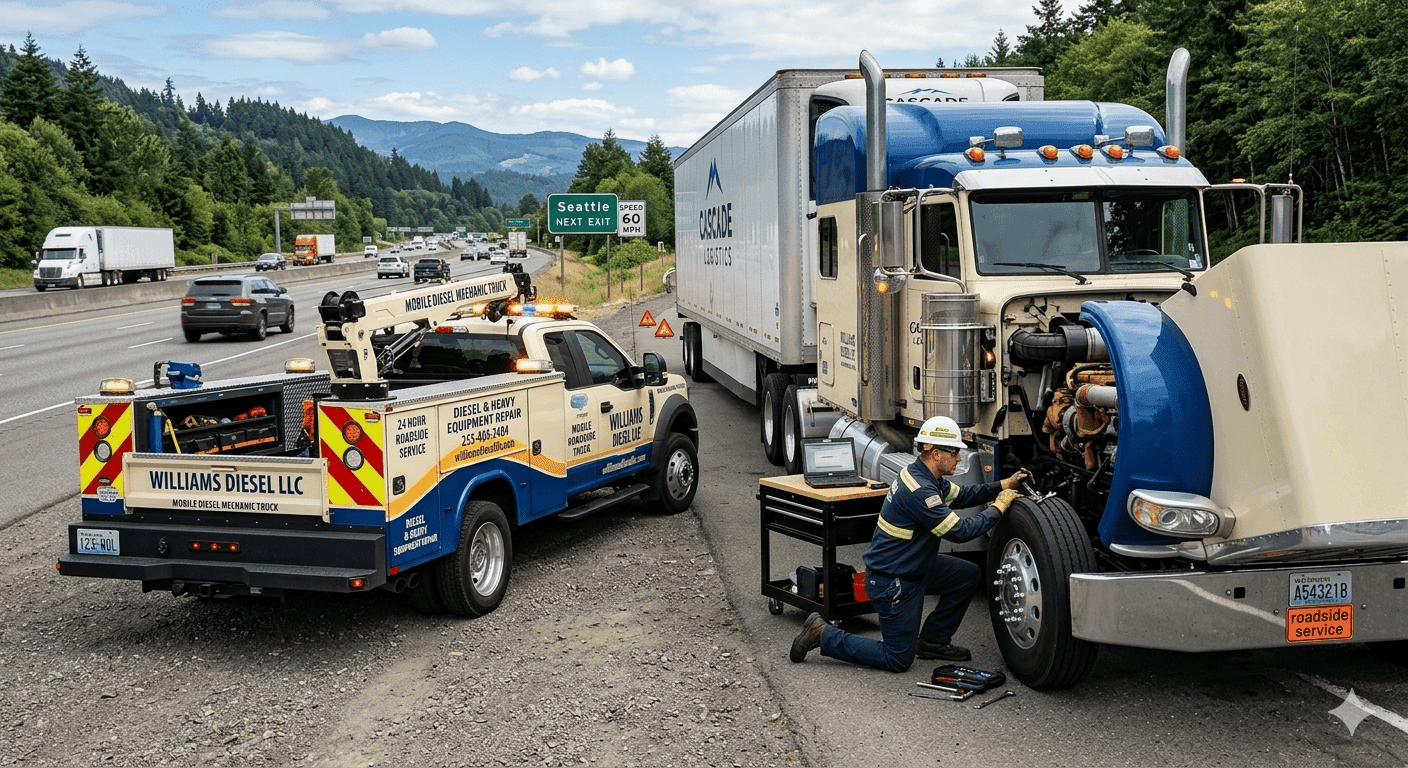
There is a common misconception that a mobile repair vehicle is simply a basic pickup truck loaded with some standard hand tools and a bottle jack. In reality, a modern heavy-duty mobile service unit functions as a high-tech rolling laboratory. These specialized platforms are custom-built to safely transport heavy tools, high-capacity fluid systems, and sensitive diagnostic equipment across demanding highway conditions.
A true heavy-duty service rig carries an array of specialized equipment, including:
- High-Output Rotary Air Compressors: Critical for powering heavy pneumatic impact wrenches and pressure-testing commercial brake lines.
- On-Board Welder-Generators: Allowing technicians to execute structural repairs on cracked frames, landing gear, or trailer doors right on the shoulder.
- Integrated Fluid Evacuation and Delivery Systems: Designed to safely capture contaminated oils or pump high volumes of fresh hydraulic fluid and coolant without environmental spills.
- Heavy Lifting Cranes and Booms: Enabling a single technician to lift and replace heavy components like starter motors, brake drums, or fifth wheels safely on the side of the road.
By carrying these industrial systems directly to the field, mobile technicians don’t just assess the problem—they solve it conclusively where it stands.
The Financial Reality: Mobile Repairs vs. Commercial Towing Fees
When looking closely at fleet operational budgets, the hidden expenses of traditional garage repairs quickly become apparent. A standard heavy tow can cost thousands of dollars just to move a vehicle a few miles down the road. Once the truck arrives at a conventional repair center, it is typically parked in an intake lot, waiting hours or days for an open service bay and an available technician.
Choosing a mobile diesel mechanic truck model eliminates the towing middleman entirely. When the service unit arrives, your breakdown site effectively becomes an active, dedicated service bay. The diagnostic process begins immediately, and the technician remains fully focused on your specific machine until it is road-ready. For fleet managers overseeing tightly scheduled logistics chains, avoiding secondary yard tracking, cargo re-routing, and tow hooks can save thousands of dollars per mechanical incident.
Troubleshooting Electronics and Forced Regenerations on the Shoulder
The mechanical landscape has changed significantly over the past decade. Today’s commercial vehicles are highly complex electronic networks governed by multiple interconnected modules. A significant percentage of modern highway failures are caused by electrical gremlins, sensor faults, or emissions control anomalies rather than pure mechanical breakage.
When a truck enters an automatic engine derate or activates a critical Diesel Particulate Filter (DPF) warning light, specialized diagnostic software is required to clear the code. A professional mobile unit carries ruggedized laptops running dealership-level software capable of deep-diving into the truck’s engine control units. Whether the fix requires replacing a bad nitrogen oxide (NOx) sensor, resolving a wire harness rub, or executing a forced DPF regeneration on the shoulder, a technician trained in truck and diesel repair can execute these technical fixes on-site. This specialized care ensures the vehicle stays out of “Limp Mode” and avoids long shop visits for simple component calibrations.
Preventive Fleet Maintenance Meets Roadside Versatility
While emergency breakdown support is the most common use case for mobile service units, smart fleet operators are increasingly using these vehicles for proactive preventative maintenance. Scheduling regular inspections can be tough when your trucks are constantly on the move, but bringing the service directly to your terminal or yard changes the equation completely.
A commercial diesel repair service delivered via a mobile platform can easily manage scheduled oil analysis draws, filter renewals, brake shoe replacements, and comprehensive department of transportation (DOT) safety inspections during a driver’s scheduled rest break. By conducting these maintenance tasks at your facility or staging yard, you eliminate the non-revenue-producing labor hours spent driving equipment back and forth to an off-site shop. It is a highly efficient way to manage a fleet, keeping your equipment compliant and completely ready for the road.
Managing Safety Hazards in High-Traffic Corridors
Broader logistics corridors, such as the major freeways crossing Washington, present dangerous environments for stranded drivers. Sitting on a narrow highway shoulder with a disabled truck poses clear safety risks from fast-moving traffic and unpredictable weather conditions.
A rapid mobile response acts as a vital safety buffer. Technicians position their large, brightly lit service rigs behind the disabled truck, creating a physical barrier and using high-visibility strobe lights to alert oncoming motorists early. Getting the truck diagnosed, repaired, and back into traffic lanes quickly keeps your driver, your cargo, and the general motoring public safe.
The Power of Specialist Expertise Over General Roadside Help
It is important to remember that general roadside clubs are usually built to handle passenger vehicles or light consumer trucks. They often lack the heavy-duty jacks, high-torque impact guns, and specialized diesel knowledge required to work safely on complex commercial air brake assemblies or high-pressure fuel rails.
Entrusting your heavy assets to a generic provider can lead to incorrect diagnoses, parts mismatches, or accidental component damage. Working with a dedicated provider like william diesel repair specialists guarantees that the technician arriving at your vehicle works on heavy diesel systems every single day. They understand the exact torque values, system pressures, and component vulnerabilities unique to major engine platforms, providing a fast, long-lasting fix instead of a temporary band-aid.
Supporting Construction, Agricultural, and Vocational Fleets
Roadside emergencies aren’t limited to over-the-road freight trucks. Construction fleets, concrete mixers, dump trucks, and waste-management vehicles operate under harsh, high-friction conditions that can cause sudden component failures. Because these specialized vocational vehicles are often heavy and awkward to transport on standard trailers, traditional towing is difficult or impossible.
A mobile heavy-duty service unit is the perfect solution for these specialized machines. Whether an excavator has blown a main hydraulic line on a job site or a dump truck has suffered an air system failure at a gravel pit, a mobile technician can travel directly to the dirt. This specialized job site support helps project foremen keep their projects on schedule and avoids costly idleness across the entire construction crew.
FAQs Section
- What specific types of repairs can a diesel mechanic truck complete on the roadside? A mobile service unit can handle a wide range of repairs on-site, including hydraulic hose fabrication, air brake chamber replacements, alternator and starter swaps, cooling system leaks, sensor replacements, electrical harness repairs, and advanced computer diagnostics like clearing codes or forced DPF regenerations.
- What is the typical response time for an emergency roadside dispatch in the Seattle area?
Response times depend on traffic conditions and your exact location, but local emergency dispatches are typically initiated immediately. We focus on providing realistic ETAs so fleet managers can make informed adjustments to their delivery schedules. - Can your mobile units service heavy construction equipment as well as over-the-road trucks?
Yes. Our mobile units are equipped with high-capacity tools and advanced diagnostic software suited for both on-road commercial transport trucks and off-road heavy construction equipment like loaders, excavators, and vocational fleets. - How do mobile repair costs compare to traditional truck repair shops?
While mobile services include a service call fee to cover travel and dispatch logistics, they save you money overall by eliminating heavy towing fees. By diagnosing and fixing the truck right on-site, you also reduce total down-time hours, saving your business significant revenue. - Do your technicians carry common replacement parts on the truck?
Yes. Our mobile units are stocked with high-demand commercial truck components, including standard filters, sensors, brake valves, belts, hoses, and electrical fittings. If a unique or proprietary part is required, our local logistics network helps source it quickly to minimize your wait time.
Conclusion: Reliable Protection for Your Fleet
The transportation industry moves fast, and unpredictable mechanical failures will always be a part of long-haul logistics. However, a breakdown doesn’t have to break your budget or stall your company’s momentum. Utilizing a professional mobile service model allows your business to bypass the high costs, long delays, and administrative headaches of traditional commercial garages.
Williams Diesel LLC remains a trusted, mechanic-led partner for fleets and owner-operators across the region. We combine advanced technical knowledge with rapid mobile response to deliver exceptional service right to your vehicle’s location. The next time you face an unexpected breakdown and find yourself searching for a dependable truck mechanic near me, skip the tow hook and opt for an on-site fix instead. Let our team protect your assets, your driver safety, and your bottom line with a professional, fully equipped diesel mechanic truck ready to respond 24 hours a day.


Comments are closed