


Quick Summary
- Unexpected highway breakdowns on busy Washington corridors like I-5, SR-99, or I-90 require fast, systematic troubleshooting before dispatching a road service unit.
- Conducting preliminary electrical, fuel delivery, and fluid level checks helps identify simple faults and provides technicians with precise diagnostic data.
- Calling an experienced emergency diesel repair Seattle provider ensures that when on-site assistance is required, mechanics arrive with the exact tools and parts needed.
- Understanding common failure points—such as tripped kill switches, loose battery grounds, and saturated fuel filters—can save hours of downtime and thousands in towing bills.
- Commercial operators across Western Washington rely on Williams Diesel LLC in Eatonville, Washington, for responsive, affordable, and honest heavy-duty diesel diagnostics and field repairs.
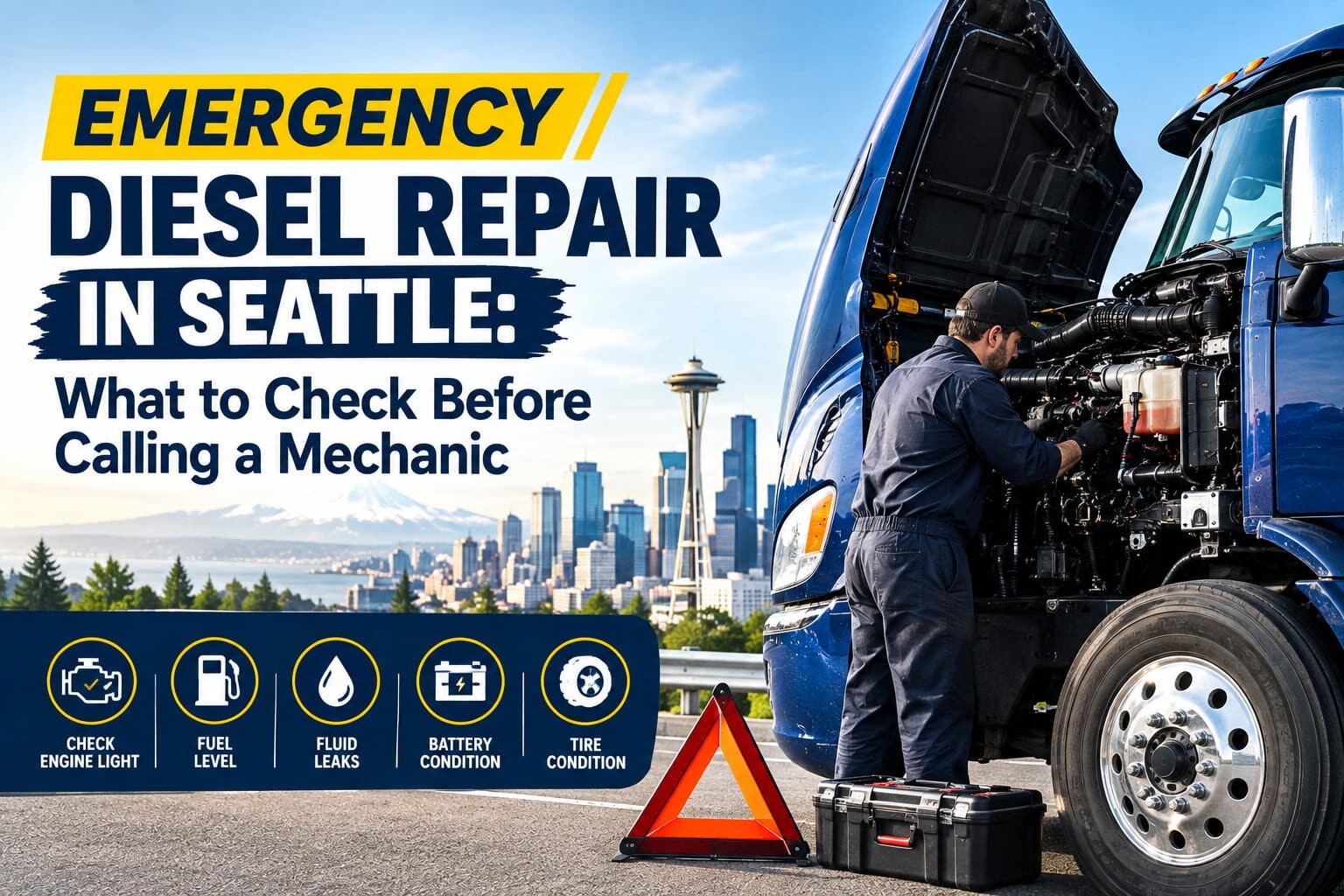
Pulling heavy cargo through Western Washington pushes commercial powertrains to their thermal and mechanical limits. Between steep mountain corridors, stop-and-go metro congestion, and relentless coastal rain, modern diesel engines face harsh operating conditions year-round. When your engine suddenly loses boost, stumbles at idle, or refuses to turn over on a narrow shoulder of Interstate 5 or near the Port of Seattle, the situation quickly turns stressful. Before you panic and immediately request a heavy wrecker, taking ten minutes to perform structured preliminary checks can save you valuable hours and substantial money.
Knowing what to inspect—and when to bring in professional emergency diesel repair Seattle technicians—puts you in command of an unexpected breakdown. Commercial carriers and fleet managers across Eatonville, Washington, and adjacent regions depend on Williams Diesel LLC to deliver dependable, transparent, and prompt field assistance when on-site mechanical intervention becomes necessary.
Safety First: Securing Your Perimeter on Washington Corridors
Before grabbing a flashlight or popping the hood latches, you must establish an uncompromising safety perimeter. Fast-moving traffic along Seattle freight routes presents an immediate hazard to stranded drivers.
1. Position the Rig on Stable Ground
If the truck still has roll momentum or minimal propulsion, maneuver as far onto the right-hand shoulder as possible. Avoid stopping on soft grass, blind freeway curves, or narrow bridge spans. Set your parking brakes firmly once stationary.
2. Activate Warning Signals
Turn on your four-way hazard flashers immediately. Keep your low-beam headlights and roof marker clearance lights illuminated to maximize your profile through marine drizzle or low-light fog.
3. Deploy DOT Warning Triangles
Federal regulations require reflective warning devices to be placed on the highway within ten minutes:
- Place the first triangle on the traffic side ten feet behind your bumper.
- Place the second triangle one hundred feet directly behind your vehicle.
- Place the third triangle approximately two hundred to three hundred feet back to give oncoming motorists ample warning to merge left.
4. Stay Clear of Traffic Lanes
Never stand on the driver-side running board next to active highway traffic. Exit through the passenger door if necessary, step over the roadside guardrail, and inspect your engine from a safe vantage point.
Essential Electrical Diagnostics: Beyond Dead Batteries
Modern common-rail diesel engines depend entirely on clean, stable voltage. Even a slight voltage drop can confuse the Engine Control Module (ECM), causing sudden shutoffs or cranking refusals.
Roadside Electrical Diagnostic Sequence
Battery Terminals: Inspect posts for green/white sulfate crust; test cable lugs for physical movement.
Ground Straps: Verify engine-to-chassis braided ground cables are clean, tight, and free of corrosion.
Battery Voltage: Check in-cab digital voltmeter (must read 12.4+ V static, 10.5+ V under active cranking).
Fuses & Relays: Check the main ECM power fuse and swap the starter relay with an identical spare circuit.
Safety Switches: Confirm master battery disconnect switch is seated and neutral safety switch is engaged.
Inspecting Battery Terminals and Ground Straps
Pacific Northwest dampness accelerates galvanic corrosion. Look closely at your dual or quad battery bank. Heavy white or bluish-green sulfate crusting on terminal posts introduces high electrical resistance. Grab the cable ends and attempt to twist them by hand; if a terminal moves on the post, it cannot deliver the heavy amperage required by high-torque starters.
Check the primary chassis and engine ground straps. A corroded engine ground often permits low-draw cabin accessories to function while completely starving the starter motor and ECM of current.
Verifying Starter Engagement and Relays
Turn the key to the run position and listen closely. Do you hear a sharp, single metallic click, rapid clicking, or complete silence?
- Rapid Clicking: Typically indicates weak battery charge or severe terminal resistance under load.
- A Single Hard Clunk: Points toward a seized starter solenoid, damaged flywheel ring gear teeth, or a hydro-locked cylinder.
- Total Silence: Suggests an open ignition circuit, a blown primary ECM fuse, an unseated neutral safety switch, or a tripped master battery cutoff switch.
Fuel System Troubleshooting: Priming, Filters, and Air Intrusion
Fuel delivery anomalies are the leading cause of unexpected highway stalls. Modern fuel systems operate at pressures exceeding 30,000 PSI, leaving zero tolerance for fuel starvation or air bubbles.
Draining the Fuel-Water Separator
High regional humidity and sudden temperature drops cause condensation inside commercial fuel tanks. Water drops to the bottom of the fuel-water separator bowl. Inspect the clear sight bowl; if you see a distinct amber-and-clear fluid separation line, loosen the drain petcock and purge the water into a container until clean diesel flows.
Identifying Saturated Filters and Fuel Starvation
When a diesel engine suddenly sputters and dies under sustained load, the primary or secondary spin-on fuel filter is often plugged with paraffin wax, biological algae, or fine silt. If your truck is equipped with a manual primer plunger, pump it repeatedly:
- If the plunger offers firm resistance within five to ten strokes, fuel system pressure is relatively stable.
- If the primer feels spongy, free-wheeling, or refuses to stiffen, air is entering the suction side of the fuel line, or the lift pump has failed completely.
Following structured diesel truck no start troubleshooting procedures helps you determine whether a simple filter spin-on will solve the failure or if an internal high-pressure fuel pump issue requires dedicated shop tools.
Air Induction and Cooling System Inspection
A diesel engine requires massive volumes of clean air to sustain compression ignition. Any compromise in air intake plumbing or engine cooling triggers immediate electronic safeguards.
Inspecting Intercooler Boots and Clamps
Sustained pulling up mountain grades exposes charge-air cooler (CAC) boots to extreme boost pressures. A blown silicone boot or loose T-bolt clamp causes a loud whooshing sound, severe power loss, and dense black smoke. Inspect the heavy rubber couplings connecting your turbocharger to the intercooler; reseating a slipped boot and tightening the clamp with a deep socket can resolve the problem immediately.
Checking Fluid Levels Safely
Never open a pressurized radiator cap on a scorching engine. Instead, inspect the transparent plastic coolant degas bottle. Modern commercial diesels feature low-coolant level probes that trigger an automatic shutdown within thirty seconds of detecting an empty reservoir. If the coolant level has dropped below the minimum sensor line, topping it off with compatible extended-life coolant may disengage the shutdown sequence.
Understanding Dashboard Faults and Mechanical Limits
When dashboard electronics light up, understanding the underlying cause helps you convey vital details to your road service dispatcher. Complex mechanical breakdowns—such as cracked cylinder heads, stuck injectors, or severe problems in diesel engine systems—demand the intervention of a certified technician equipped with specialized hardware.
When your rig requires heavy mechanical disassembly or extensive semi engine repair, field mechanics run real-time sensor evaluations to determine whether on-site remediation is possible or if a structured shop overhaul is necessary.
Typical Breakdown Warning Hierarchy
Amber Check Engine Light: Non-critical emissions or sensor variance; vehicle operational with caution.
Flashing DEF / DPF Icon: Soot loading or fluid dosing issue; forced stationary regen required soon.
Red Stop Engine Light: Critical oil pressure drop, high coolant temp, or low coolant level; shut down immediately.
Derate Countdown Timer: ECM speed capping in progress; vehicle will restrict to 5 MPH once timer expires.
When to Call for Professional Mobile Roadside Assistance
If basic checks reveal intact cables, clean fuel filters, and topped-off fluid levels, the breakdown likely involves internal sensors, high-pressure common-rail components, or complex electronics. In this scenario, calling for specialized roadside commercial truck repair is the most cost-effective decision.
Professional mobile technicians arrive in dedicated service vehicles equipped with commercial air compressors, oxy-acetylene torches, high-torque hydraulic jacks, and OEM-level software. Connecting diagnostic hardware directly to the truck’s J1939 data port allows the mechanic to run comprehensive mobile diesel engine diagnostics, checking live fuel rail pressures, cylinder contribution balances, and turbocharger actuator sweeps right on the shoulder.
Relying on seasoned professionals who provide emergency semi truck repair Washington drivers trust prevents unnecessary towing damage to drive axles and aerodynamic fairings.
Bridging Operational Cracks with Equipment Rental
A severe mechanical failure on an essential commercial transport truck or service rig can interrupt project schedules for days. When a cracked manifold, failed injection pump, or damaged transmission forces your vehicle into an extended repair bay stay, project deadlines and delivery commitments continue to march forward.
Forward-looking contractors and logistics operators navigate these delays by integrating flexible equipment rental options into their contingency plans. Renting replacement heavy-duty haulers, flatbed transport trucks, or specialized earthmoving machinery keeps your crews productive and your contracts intact while primary equipment undergoes major mechanical overhauls. Having access to rental machines provides project managers with breathing room, ensuring repairs are completed correctly rather than rushed under pressure.
Fleet Reliability and Regional Roadside Support
Preventive maintenance is the backbone of commercial profitability. Fleets that partner with dedicated local providers like williams diesel repair avoid the recurring breakdowns that plague neglected rigs.
Managing scheduled filter changes, oil analyses, and sensor updates across multiple commercial units keeps operating costs predictable. For companies operating local distribution routes across Puget Sound, establishing a contract for dependable diesel fleet road service Seattle providers offer guarantees prioritized roadside response, reduced labor rates, and reliable mechanical support across every mile.
When a sudden mechanical emergency leaves you searching the web for dependable emergency diesel repair near me, working with an established local team ensures you bypass generic towing brokers and connect directly with skilled mechanics who know how to get your equipment moving again.
Frequently Asked Questions
How quickly can a mobile technician arrive at my breakdown location in Seattle?
Average response times across the greater Seattle metropolitan area generally range between 60 and 90 minutes. Actual arrival times depend on current traffic conditions along key arteries like I-5, SR-99, and I-90, as well as weather and the exact breakdown location.
What information should I have ready when calling for emergency diesel repair?
Have your exact mile marker or street intersection, truck year, make, model, engine type (e.g., Cummins X15, Detroit DD15, Power Stroke), trailer status, observed symptoms (leaks, noises, smoke color), and any active dashboard fault codes ready for the dispatcher.
Can a mobile diesel mechanic fix an active DEF speed derate on the highway shoulder?
Yes. Fully equipped mobile repair units carry advanced diagnostic scanners capable of communicating with your vehicle’s engine and aftertreatment controllers. Technicians can diagnose NOx sensor faults, clean dosing injectors, initiate forced stationary regenerations, and reset derate countdown timers on-site.
What geographical regions are covered by Williams Diesel LLC?
Williams Diesel LLC provides emergency roadside assistance, field diagnostics, and heavy mechanical repairs throughout Eatonville, Seattle, Tacoma, King County, Pierce County, and surrounding Western Washington transportation corridors.
Is emergency roadside repair cheaper than towing my truck to a dealership?
In roughly 75% of commercial breakdown scenarios, mobile roadside repair is substantially more cost-effective than towing. A heavy-duty tow across King County can easily exceed $1,500 to $3,000 before diagnostic fees begin, while mobile mechanics can often diagnose and resolve the fault on the shoulder for a fraction of that cost.
Conclusion and Final Thoughts
Experiencing an unexpected breakdown on a busy Washington highway is one of the most frustrating challenges a commercial driver or fleet manager can face. However, a sudden engine failure does not have to result in days of wasted downtime, missed delivery windows, or exorbitant towing invoices. By following an orderly roadside inspection protocol—checking battery connections, draining water separators, verifying fuel primer resistance, and securing intake boots—you eliminate simple mechanical oversights and provide technicians with actionable data.
When on-site troubleshooting reaches its limits and you require dependable emergency diesel repair Seattle fleets rely upon, having a trusted partner on speed dial makes all the difference. Williams Diesel LLC remains committed to providing professional, affordable, and honest heavy-duty diesel diagnostics and emergency repairs across Eatonville, Washington, and the greater Seattle region. Keep their contact information stored in your cab to ensure that wherever regional roads take you, professional roadside support is only a phone call away.
Do not let an unexpected breakdown leave your freight stranded on the highway shoulder. Contact Williams Diesel LLC now for prompt mobile dispatch, emergency diagnostics, and reliable on-site diesel repairs.

Comments are closed