


Summary
- Conducting a systematic pre-shift assessment protects workers, maintains OSHA compliance, and prevents expensive job delays.
- Securing a scissor lift rental Seattle package requires checking critical systems such as hydraulic lines, emergency shutoffs, tire treads, and interlocks.
- Environmental hazards common across Western Washington—such as slick concrete, grade shifts, and overhead utilities—demand vigilant site reviews before elevating the deck.
- Verifying baseline functions, including pothole protection guards and ground-level descent valves, ensures equipment responds correctly in an emergency.
- Commercial trades and general contractors count on Williams Diesel LLC in Eatonville, Washington, for fully inspected, dependable access platforms and job-ready machines.
Taking on mechanical retrofits, commercial electrical installs, or warehouse ceiling work in the Pacific Northwest requires dependable aerial access. When working on high-bay facilities, aircraft hangars, or urban tenant improvements, managing overhead work safely comes down to equipment reliability. Bringing in a trusted scissor lift rental Seattle contractors depend on gives your crew elevated reach, steady platform stability, and the capacity to lift both personnel and heavy tooling. However, taking delivery of a lift is only the first step.
Before an operator steps onto the deck and hits the joystick, running through a disciplined pre-operation inspection is essential for site safety and regulatory compliance. For general contractors, commercial painters, and HVAC installers operating in Eatonville, Washington, and across the Puget Sound corridor, Williams Diesel LLC delivers clean, dependable, and thoroughly inspected aerial work platforms ready for demanding shifts.
Safe at height starts on the ground. Rent thoroughly inspected, job-ready scissor lifts with Williams Diesel LLC. Fast delivery, flexible rates, and dependable local service. Call or message us today to get your quote!
Why Pre-Operation Inspections Protect Your Crew and Margins
Job sites are high-paced environments where tight milestones put pressure on daily output. Bypassing a morning equipment walk-around to save ten minutes is a gamble that risks severe workplace injuries, equipment damage, or stop-work orders from safety inspectors.
A thorough scissor lift pre-operation inspection establishes an immediate mechanical baseline before work begins. It confirms that the previous shift did not over-stress a hydraulic cylinder, crack a structural weld, or drain the battery bank to critical levels. Catching a weeping hose or a sticking interlock switch on the ground takes minutes; dealing with a scissor stack frozen at a twenty-six-foot working height stops work for the entire crew and incurs unexpected field-service expenses.
Federal and state regulations require daily walk-arounds for a reason. Taking a proactive approach ensures your team identifies mechanical wear before it creates a hazard, keeping operators confident and focused on the work at hand.
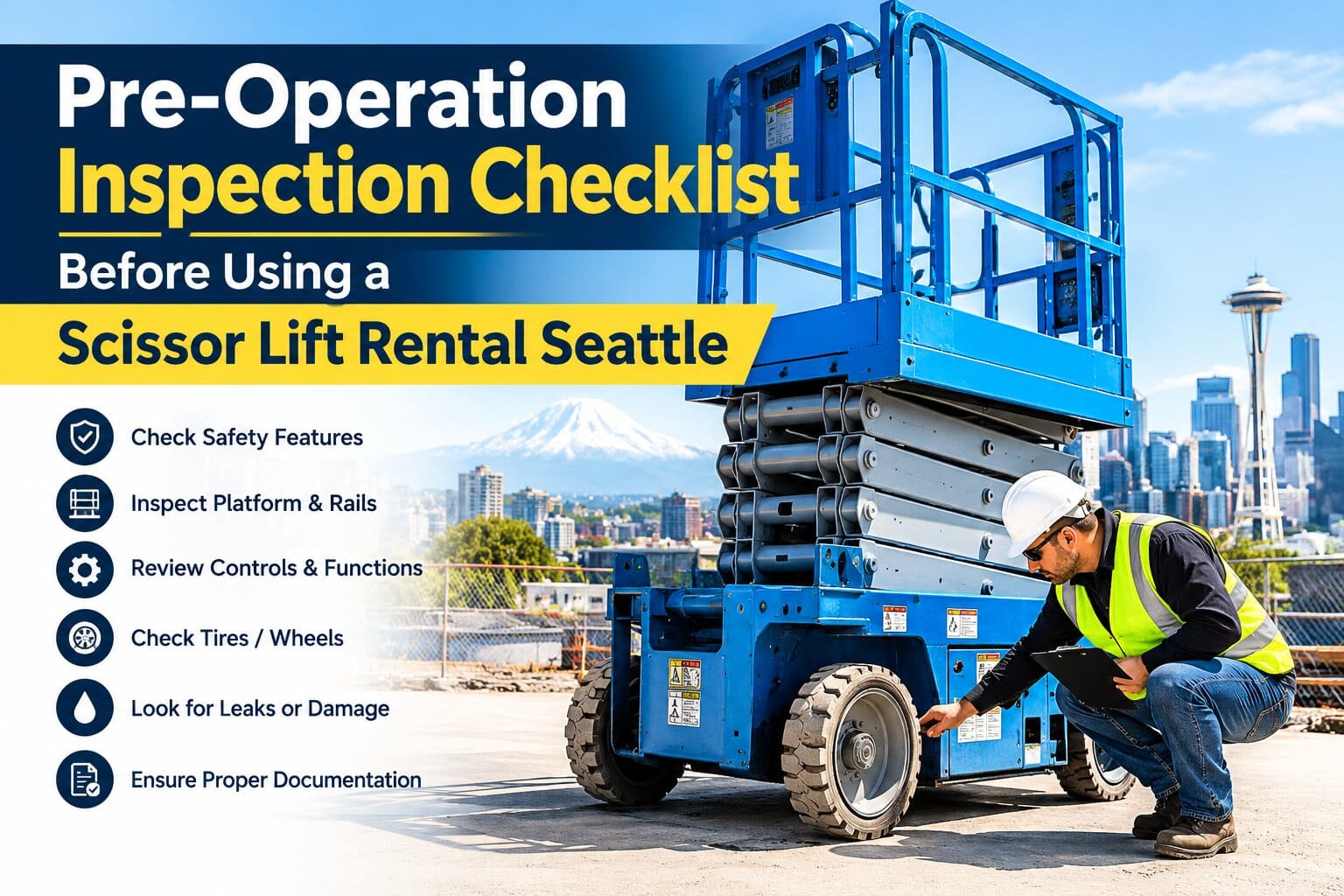
The Complete Walk-Around: Ground-Level Component Checks
Every inspection should follow an orderly path around the perimeter of the chassis before anyone touches the upper controls. This physical check reveals damage that may have occurred during flatbed transport or previous shifts.
Wheels, Tires, and Pothole Protection Bars
Begin at the base of the machine. The running gear carries the entire balance of the elevated platform:
- Tire Condition: Most indoor slab lifts utilize solid, non-marking rubber tires. Inspect the rubber for deep structural gouges, embedded screws, or sidewall chunking that could cause a tilt variance under load. If working with rough-terrain units, verify tread depth and ensure pneumatic or foam-filled tires maintain even pressure.
- Lug Nuts and Hubs: Ensure wheel lugs are fully seated without signs of rust trailing from bolt holes, which points to loose fasteners.
- Pothole Skirts: Modern slab scissor lifts feature mechanical pothole protection channels that deploy downward when the platform elevates. Inspect the deployment linkage, hinges, and limit switches to ensure clear travel free from compacted dirt, job site drywall mud, or bent steel arms.
Scissor Stack Structural Integrity
The scissor assembly handles enormous compressive and torsional forces when lifting personnel and tools:
- Structural Steel and Welds: Inspect the rectangular box tubing of each scissor arm for dents, bends, or hairline fractures along weld seams. Dents sustained from forklift collisions can compromise the structural load capacity of the arm.
- Pins, Bushings, and Retainers: Inspect the pivot pins connecting scissor pairs. Ensure retaining bolts, snap rings, and cotter pins are intact. Listen for dry grinding or groaning during elevation, which signals ungreased brass bushings.
- Maintenance Safety Props: Verify the integrated mechanical safety prop (scissor stand) swings into place and secures cleanly within its retaining pocket. Never place an arm or body part between un-propped scissor beams during maintenance or inspection.
Hydraulic Routing and Fluid Reservoirs
Hydraulic leaks on polished concrete or finished commercial floors cause slip hazards and expensive surface remediation:
- Hose Routing: Trace hydraulic hoses as they travel through the scissor scissor stack. Ensure hoses sit inside protective nylon sleeves and are routed through designated hose clamps so they cannot get pinched as the mechanism folds down.
- Cylinder Seals: Inspect the chrome rod of the main lift cylinder. Look for deep scoring, rust pitting, or weeping fluid rings around the gland nut.
- Tank Levels: Check the sight glass on the hydraulic fluid reservoir while the lift is completely lowered. Low fluid levels cause pump cavitation, erratic lifting speeds, and spongy platform descent.
Platform and Operator Control Inspections
Once the machine passes ground-level checks, examine the operator basket, guardrail perimeter, and control interfaces.
Guardrails, Anchor Points, and Entry Gates
The platform serves as the operator’s primary protective envelope at height:
- Guardrail Framing: Shake the top rail firmly. The railing must be rigid, free from cracked tube joints, and bolted securely to the platform floor. Mid-rails and four-inch toe boards must be complete to prevent tools from being kicked off the edge.
- Entry Gate Latching: Step through the entry gate. The gate must swing closed automatically under spring tension and latch securely. Chains or sliding drop-bars must seat completely; gravity gates that hang open pose a major fall hazard.
- Lanyard Anchorage Points: Inspect designated fall arrest anchor loops welded to the deck floor or frame. Confirm there are no bent anchor plates or cracked floor welds.
- Extension Deck Slide Locks: Slide the manual rollout deck forward. The deck should slide smoothly on its rollers and drop firmly into its locking pins without binding.
Functional Testing of Platform Controls
Power on the control box and test every function at minimal height before elevating into your working zone:
- Joystick Dead-Man Trigger: Test the interlock trigger switch on the drive/lift joystick. The machine must not move or elevate unless the interlock is depressed. Releasing the trigger must immediately halt movement.
- Emergency Stop (E-Stop) Pushbuttons: Push the red mushroom-style E-Stop button down on the platform console; all machine control should cut out instantly. Pull the button out, repeat the check on the base control box, and confirm that both circuits function independently.
- Steer and Drive Response: Drive the unit forward and reverse several feet on a level surface. Test steering angles to ensure immediate wheel tracking without slipping or hydraulic hesitation.
Critical Safety Systems and Emergency Lowering Protocols
An elevated crew must always have a reliable way down, even in the event of an electrical blackout, drained battery, or severed control harness.
Emergency Descent Valve Verification
Every scissor lift features a manual auxiliary lowering control located at the base chassis. This valve bypasses all electrical solenoids, releasing hydraulic pressure back to the tank using gravity alone.
Pull the manual lowering cable ring or twist the auxiliary lowering valve while an assistant monitors the platform. The scissor stack should descend smoothly at a controlled rate. If this mechanical bypass binds or fails to lower the deck, take the machine out of service immediately.
Tilt Sensor and Alarm Calibration
Operating an elevated scissor lift on an incline exceeding manufacturer ratings (typically 1.5 to 3 degrees sideways, and 3 degrees fore-and-aft) poses a severe rollover risk.
Raise the platform approximately six feet and gently drive onto a known test incline or trigger the chassis tilt sensor. The machine should sound a piercing audible alarm, flash an overhead beacon, and automatically disable the drive and lift-up circuits while still permitting lift-down operation.
Environmental and Worksite Hazards in Western Washington
Equipment condition is only half of the safety equation; the surrounding operating environment plays an equally important role. When organizing an aerial lift rental Seattle trades utilize on commercial sites, local terrain and weather must be factored into your daily hazard assessment.
Identifying Overhead and Surface Obstacles
- Overhead Electrical Lines: Maintain a minimum clearance distance of at least ten feet from high-voltage distribution lines up to 50kV. Assume all overhead cables are energized until written utility confirmation proves otherwise.
- Slab Penetrations and Floor Openings: Mark, cover, and secure all floor trenches, plumbing cutouts, and elevator pits. Hitting an unguarded four-inch core hole at low speeds can cause an elevated platform to tip sideways.
- Grades and ramps: Driving a scissor lift up loading dock ramps or transition thresholds requires extreme caution. Keep the platform completely retracted, travel straight up or down the slope, and avoid turning across the grade.
Fleet Versatility: Integrating Heavy Equipment Rental
Large commercial builds and complex infrastructure developments rarely depend solely on indoor access equipment. A commercial project often starts with earthwork and utility trenches, transitions to structural steel framing, and concludes with interior MEP (mechanical, electrical, and plumbing) installations.
Smart general contractors streamline their operations through comprehensive equipment rental programs. Rather than dealing with multiple vendors, coordinating machinery through a single regional provider simplifies delivery, minimizes billing confusion, and ensures uniform maintenance standards across your entire fleet.
Working with an established provider for heavy equipment rental Seattle allows project managers to source mini excavators, flatbed haulers, and elevated access equipment simultaneously. Having a unified equipment strategy keeps equipment deliveries aligned with project milestones.
Powertrain Maintenance: Electric vs. Engine-Driven Units
Matching the correct drive system to your working environment avoids operational head-scratching and air-quality violations on site.
Slab Electric Lifts
Interior tenant buildouts and distribution centers require zero-emissions equipment. Opting for an electric scissor lift rental provides silent operation and smooth proportional electric driving.
During your daily inspection, check the deep-cycle battery bank:
- Check water levels in lead-acid cells (top off with distilled water if plates are exposed).
- Inspect heavy-gauge terminal cables for green corrosion or melted insulation.
- Ensure the on-board charger completes its charging cycle overnight; low-voltage batteries cause erratic lift performance and premature solenoid drop-out.
Diesel and Rough-Terrain Lifts
Exterior commercial projects demand robust four-wheel-drive capability, heavy oscillation axles, and high ground clearance. Engine-driven platforms rely on durable diesel engines to run high-output hydraulic pumps. When conducting your walk-around, verify diesel fluid levels, inspect intake air pre-cleaners, and check fuel lines for weeping fittings.
Partnering with technical professionals who understand commercial powertrains—such as the specialized teams at williams diesel repair and the fleet division at williams equipment rentals—ensures that every rental arrives with clean filters, fully serviced hydraulics, and peak engine performance.
Whether an electrical glitch halts an indoor slab machine or an engine fault stalls an outdoor rig, scheduling a comprehensive scissor lift safety inspection with certified technicians guarantees your equipment stays compliant with ANSI A92.20 standards.
Balancing Overhead with Budget-Conscious Fleet Strategies
Equipment costs represent a substantial portion of any subcontractor’s operating budget. Project estimators frequently compare equipment lines to find affordable equipment that meets commercial specs without compromising worksite safety.
Relying on low-tier, cut-rate providers can lead to hidden costs. Cheap rental platforms often arrive with worn control harnesses, leaky cylinders, or slipping drive motors, resulting in hours of lost field productivity. Savvy operators seek out budget equipment rentals that balance reasonable daily rates with rigorous fleet maintenance standards.
When you need an immediate aerial work platform for an unexpected shift and search for a dependable scissor lift rental near me, choosing an established local outfit ensures direct communication, verified equipment quality, and dependable support.
Frequently Asked Questions
What should I do if the scissor lift tilt alarm sounds while elevated?
Immediately stop elevating or driving the machine. Look down to assess your chassis position. Slowly and carefully lower the platform completely using the platform joystick or ground controls. Once fully retracted, inspect the floor for unlevel transitions, debris, or soft ground. Never attempt to drive out of a tilt condition while elevated.
Do operators need special certification to run a scissor lift?
Yes. OSHA standards and ANSI A92.22/A92.24 guidelines require all operators to undergo formal Mobile Elevating Work Platform (MEWP) training. This includes classroom instruction on fall hazards and machine balance, followed by hands-on operation and evaluation on the specific class of equipment being operated.
Are safety harnesses required when working from a scissor lift?
Federal OSHA standards do not require personal fall arrest systems (PFAS) on scissor lifts provided the guardrail system is fully intact and the entry gate is securely latched. However, many general contractors and commercial project safety plans enforce strict “100% tie-off” rules that mandate harnesses with short restraint lanyards anchored to designated deck attachment points.
What is the typical local response time for field support from Williams Diesel LLC?
Williams Diesel LLC provides prompt field response throughout Eatonville, Pierce County, and surrounding Western Washington job sites. Service units typically arrive on-site within 60 to 90 minutes to handle diagnostics, hydraulic adjustments, or battery service.
Which areas are covered for equipment delivery and service?
Williams Diesel LLC provides equipment rentals, field maintenance, and transport services across Eatonville, Tacoma, Puyallup, Seattle, King County, Pierce County, and adjacent Puget Sound communities.
Conclusion and Final Thoughts
Taking safety seriously on the job site begins long before your personnel lift off the ground. A disciplined pre-operation inspection checklist ensures your equipment operates reliably, protects your workers at height, and shields your business from costly project delays and regulatory fines. By systematically checking tires, pothole skirts, scissor arms, hydraulic lines, and emergency descent valves, your crew catches minor mechanical wear before it can cause an unexpected site shutdown.
When your next project requires a dependable, compliant scissor lift rental Seattle trades trust for high-demand commercial access, partnering with an experienced regional provider makes all the difference. Williams Diesel LLC remains dedicated to supplying reliable, affordable, and fully inspected aerial work platforms to general contractors, electricians, and tradespeople throughout Eatonville, Washington, and the broader Puget Sound region. Make thorough pre-operation inspections a standard practice on every shift, and work with local equipment partners who put safety, reliability, and customer service first.
Equip your team with dependable, job-ready aerial access equipment delivered straight to your site. Contact Williams Diesel LLC today to verify platform availability, get detailed technical specs, or reserve your machine.


Comments are closed