


Summary
- Discover why securing a heavy duty truck rental in Eatonville protects your crew, equipment, and bottom line during demanding machinery transport.
- Learn how proper gross vehicle weight ratings, integrated trailer brake controllers, and heavy-duty chassis prevent dangerous roadway incidents.
- Explore the mechanical benefits of pairing one-ton work rigs with specialized trailers for seamless, code-compliant earthmoving logistics.
- Understand the core safety protocols for load distribution, tongue weight calibration, and tie-down tensioning across rural mountain corridors.
- See how local Pierce County builders eliminate expensive equipment downtime and avoid the financial strain of fleet ownership.
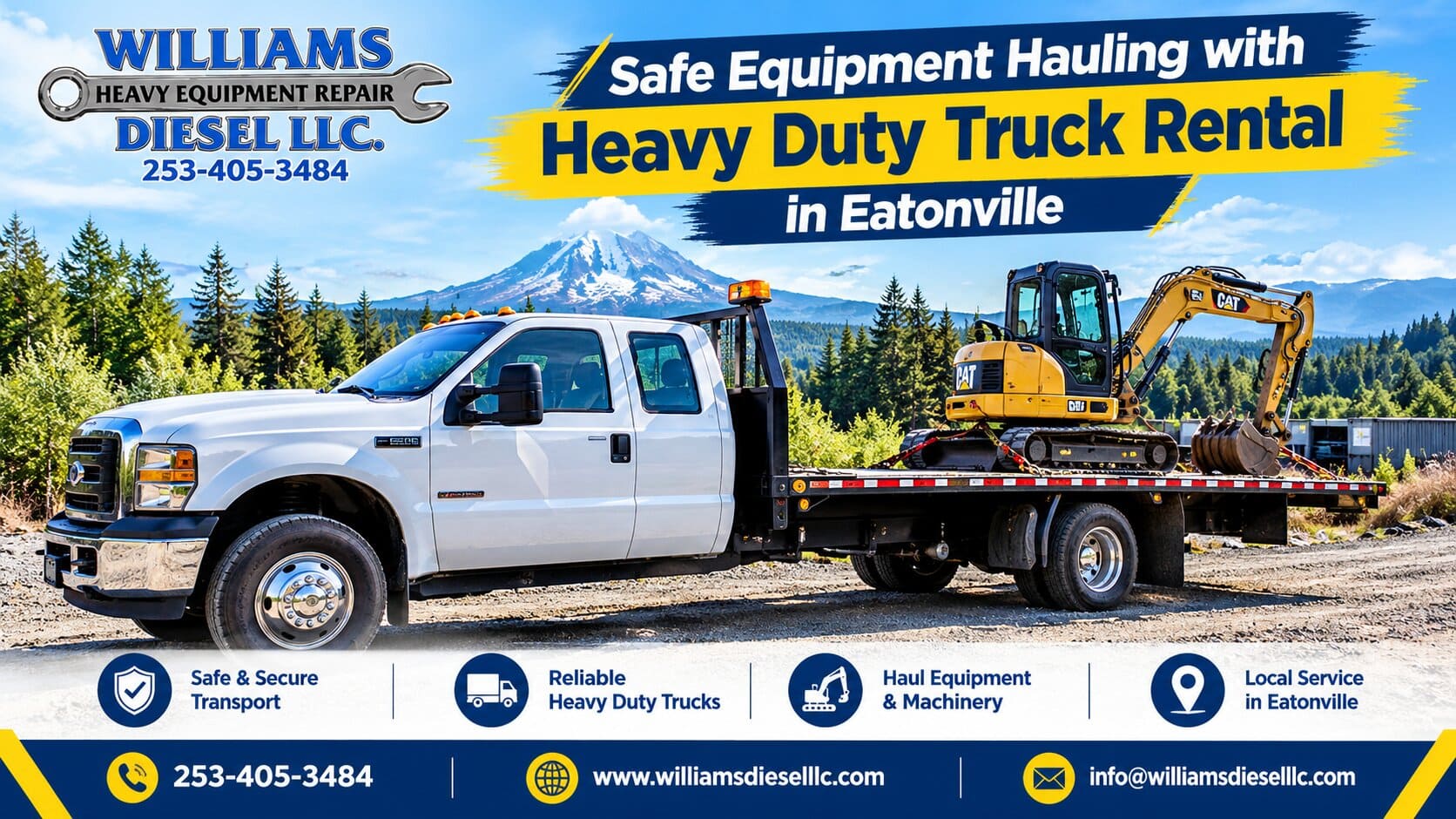
Moving heavy iron across the rural roads and rolling grades of Pierce County is never as simple as dropping a hitch onto a standard half-ton pickup. Whether you are shifting an earthmover between job sites, pulling a loaded gravel trailer to a residential foundation build, or hauling utility attachments, equipment transport demands serious towing power and commercial-grade stability. Pushing an undersized vehicle past its engineered payload limits invites transmission failure, melted brake pads, dangerous trailer sway, and severe safety violations. That is why experienced builders, landscapers, and civil subcontractors rely on a dependable heavy duty truck rental in Eatonville to execute their heavy transport safely and efficiently.
Local operations like Williams Diesel LLC serve as reliable partners across Eatonville, Seattle, and neighboring communities, providing well-maintained work trucks, machinery rentals, and responsive mechanical support that keep local projects running on schedule.
Understanding how to match machine weights with heavy-duty pulling rigs ensures your payload stays secure, your transit remains completely legal, and your crew arrives at the work zone ready to dig.
Safe equipment hauling starts here. Tap below to chat with our Eatonville rental team on WhatsApp for fast pricing and availability!
Why Vehicle Weight Ratings Matter on Rural Pacific Northwest Roads
Safe hauling begins with an honest calculation of weights and ratings. Every commercial truck carries factory-stamped weight ratings that dictate legal and mechanical boundaries: Gross Vehicle Weight Rating (GVWR), Gross Combined Weight Rating (GCWR), and Gross Axle Weight Rating (GAWR). Exceeding these numbers is not just a regulatory risk; it alters the vehicle’s center of gravity and severely diminishes steering authority.
When hauling heavy machinery around Eatonville, Highway 161, and the steep grades leading toward Mount Rainier, braking performance becomes the primary safety concern. Light-duty pickups lack the massive brake rotors, exhaust brakes, and cooling systems required to control heavy momentum down prolonged declines.
Investing in commercial truck rentals eliminates these safety vulnerabilities. Heavy-duty three-quarter-ton and one-ton work trucks feature heavy boxed steel frames, oversized leaf springs, and multi-piston disc brakes engineered specifically to absorb substantial tongue weights and severe momentum. When descending mountain grades or navigating wet, winding logging routes, an integrated engine exhaust brake controls speed without overheating service brakes, guaranteeing continuous stopping power.
Matching Power with Equipment Trailer Rentals
A powerful truck is only half the equation for safe transport. The connection between the tow vehicle and the trailer dictates how smoothly your equipment travels over uneven surfaces. Pairing your transport rig with dedicated equipment trailer rentals ensures your machines rest on level, structural-steel decks rated for high concentrated wheel and track loads.
Standard utility trailers designed for lawnmowers or building supplies lack the crossmember reinforcement needed to support concentrated steel tracks. Heavy machinery trailers feature tandem or triple axles with heavy-duty torsion or leaf-spring suspensions, integrated slide-in or flip-down steel ramps, and rub rails with welded stake pockets.
Furthermore, proper hitch configuration is critical:
- Bumper Pull (Receiver Hitch): Suited for smaller machinery setups where total trailer weight stays within Class IV or Class V ratings. Weight-distribution hitches are recommended to spread tongue loads across both vehicle axles.
- Gooseneck & Fifth Wheel Hitches: Positioned directly over the truck’s rear axle, a gooseneck attachment provides superior stability, tighter turning radiuses in narrow access lanes, and significantly higher payload thresholds, virtually eliminating the fish-tailing tendencies common with heavy loads.
The Value of Dedicated Ford F-350 Rentals in Eatonville
When contractors evaluate the ideal vehicle platform for towing heavy equipment trailers, the one-ton dual-rear-wheel or single-rear-wheel diesel pickup stands out as the commercial gold standard. Sourcing dedicated Ford F-350 rentals in Eatonville gives operators access to the raw pulling power and structural rigidity needed for demanding site mobilization.
Equipped with high-output Power Stroke turbo-diesel engines, these trucks generate immense low-end torque, making pulling heavy machinery up steep rural inclines feel effortless. The high-capacity cooling systems prevent engine and transmission fluids from cooking under sustained loads, while heavy-duty TorqShift automatic transmissions feature dedicated Tow/Haul modes that optimize shift points and provide automatic downshifting on steep downhill descents.
Finding a work-ready ford f350 for rent also gives contractors access to factory-integrated trailer brake controllers, dynamic hitch assist cameras, and heavy-duty receiver platforms. This level of purpose-built equipment removes guesswork from coupling, allowing drivers to dial in precise trailer braking voltage right from the dashboard.
Essential Principles for Safe Machinery Transport
Even the strongest truck and trailer combination cannot overcome poor loading practices. Adhering to strict transport principles guarantees safety for your driver and everyone sharing the road.
Perfecting Load Position and Tongue Weight
The golden rule of equipment hauling is achieving the proper tongue weight balance, typically 10 to 15 percent of the total trailer and machine weight for bumper-pull trailers, and 15 to 25 percent for gooseneck configurations.
- Too Much Tongue Weight (Loaded Too Far Forward): Overloads the truck’s rear axle, squats the rear suspension, lifts weight off the front steering axle, and severely impairs steering control and headlight alignment.
- Too Little Tongue Weight (Loaded Too Far Back): Causes the trailer to lift the rear of the truck, inducing violent, uncontrollable trailer sway (fishtailing) at highway speeds.
Always position the heaviest part of the machine—typically the engine block and hydraulic pump housing—just forward of the trailer’s central axle grouping.
The Four-Point Tie-Down Standard
Federal Motor Carrier Safety Administration (FMCSA) and Washington State regulations mandate strict tie-down procedures for heavy equipment. For any machine exceeding 10,000 pounds, a four-point tie-down system using transport-grade chains is required by law:
- Attach individual Grade 70 transport chains to the designated tiedown points on the four corners of the machine chassis.
- Direct chains diagonally outward and downward to the trailer rub rail or D-rings to resist front, rear, and lateral forces simultaneously.
- Secure every chain with a rated lever or ratchet load binder, securing loose handles to prevent accidental release.
- Lower all booms, buckets, blades, and outriggers directly to the trailer deck, securing hydraulic attachments with an independent fifth chain or heavy-duty strap.
Equipment Rental: Flexible Solutions for Growing Businesses
Tying up substantial working capital in specialized transport trucks and heavy machinery rarely makes sense for independent builders, agricultural operators, and specialty trade subcontractors. Modern Equipment Rental models offer a smarter financial path, giving companies immediate access to late-model, fully compliant trucks and machines without the burden of long-term commercial loans, insurance policies, and depreciation write-offs.
Opting for local work truck rentals allows contractors to bid confidently on projects requiring heavy hauling without worrying about fleet maintenance schedules. Whether you are clearing acreage, excavating foundation footings, or setting culverts, renting allows you to scale equipment size precisely to job specifications.
When your scope expands to include earthmoving, pairing your truck with renting an excavator provides a complete end-to-end package. You pick up the truck, hitch the loaded trailer, complete the earthmoving tasks, and return the equipment once the project phase concludes, converting major capital investments into predictable, job-costed business expenses.
Avoiding Costly Roadside Breakdowns and Dispatch Delays
Mechanical breakdowns in the middle of hauling equipment create major logistical nightmares, blocking roadways, delaying tight project deadlines, and racking up substantial repair expenses. Working with a dedicated provider that understands both transport demands and vehicle mechanics makes all the difference.
Reputable transport suppliers inspect every vehicle and trailer before it leaves the yard, verifying brake shoe thickness, tire inflation pressures, lug nut torque, wiring harness integrity, and fluid levels.
Furthermore, having access to experienced technicians specializing in williams diesel repair provides essential peace of mind. When your transport fleet is backed by skilled diesel mechanics who understand heavy-duty drivetrains, fuel injection systems, and electronic brake systems, you eliminate the risk of being stranded on the shoulder of rural highways.
If your own internal fleet experiences a breakdown during transit, utilizing dedicated machinery towing rentals ensures your earthmovers, skid steers, and material handlers reach the job site without having to pay exorbitant third-party heavy-wrecker fees.
The Strategic Advantage of Sourcing Equipment Locally
Navigating high-density urban traffic in Seattle or Tacoma while pulling a loaded equipment trailer wastes valuable fuel and adds unnecessary stress to your workday. Sourcing a dependable heavy duty truck rental in Eatonville gives contractors working in South Pierce, Lewis, and Thurston Counties a strategic operational base.
Securing your equipment locally eliminates long empty transit miles, bypasses Interstate 5 congestion, and provides immediate proximity to rural jobsites in Graham, Roy, Spanaway, Yelm, and Ashford. Furthermore, local providers offer flexible scheduling tailored to regional builders, allowing for early-morning pickups and after-hours drop-offs that align with active construction hours.
Local yards also provide personalized insight into area terrain, seasonal road conditions, and county bridge weight restrictions, helping drivers select the most efficient and compliant routes for their heavy payloads. When bidding seasonal projects, securing affordable heavy equipment rentals close to your primary work zone protects your operating margins and keeps your transport timeline predictable.
Pre-Trip Inspection Protocols for Heavy Equipment Hauling
Before turning the ignition and pulling onto public roads, drivers must complete a systematic pre-trip walkaround inspection:
- Tire Pressures and Tread Depth: Check cold tire inflation pressures on all truck and trailer tires using a calibrated gauge. Heavy trailers require maximum cold pressure to support rated capacities and avoid sudden sidewall blowouts.
- Hitch Locking Mechanism and Safety Chains: Ensure the coupler is fully locked over the hitch ball or pintle ring with the safety pin inserted. Verify that safety chains are crossed beneath the tongue with adequate slack to allow sharp turns without dragging on the pavement.
- Breakaway Cable System: Check that the emergency trailer breakaway cable is securely clipped directly to the truck frame, not wrapped around safety chains, and verify that the onboard trailer battery holds a full charge.
- Lighting and Electrical Signals: Connect the 7-way round electrical plug and test running lights, turn signals, hazard flashers, and brake lights to ensure total visibility.
- Load Binder Tension: Re-check all load binder handles, chain links, and tie-down tension after driving the first five miles to account for initial machine settling.
Frequently Asked Questions
Q1: What driver’s license class is required to operate a heavy duty truck rental with an equipment trailer?
In Washington State, a standard Class D driver’s license is sufficient as long as the Gross Combined Weight Rating (GCWR) of the truck and trailer stays under 26,001 pounds. If the combined rating exceeds 26,000 pounds and the trailer’s GVWR is over 10,000 pounds, a Commercial Driver’s License (CDL) is required by law.
Q2: What geographic areas and delivery zones do your Eatonville truck and equipment services cover?
Rental services primarily cover Eatonville, Pierce County, South King County, Thurston County, and Lewis County, including communities such as Graham, Roy, Puyallup, Tacoma, Yelm, and Seattle. Equipment delivery directly to your job site or facility can also be arranged.
Q3: What is the typical local response time if our rental equipment experiences an issue on site?
Because our mechanical service base is local to Pierce County, mobile diagnostic and repair dispatch typically reaches area job sites within one to two hours, ensuring minimal interruption to your workday.
Q4: Can I rent both the heavy duty truck and an equipment trailer as a bundled package?
Yes. Turnkey packages pairing heavy-duty one-ton trucks with appropriately rated equipment trailers are available, ensuring hitch heights, brake wiring, and tongue ratings match perfectly.
Q5: What insurance documentation is needed to secure a commercial truck rental?
Renters must provide a valid driver’s license, proof of commercial auto liability insurance, and a Certificate of Insurance (COI) listing the rental business as an additional insured and loss payee for rented vehicles and equipment.
Final Thoughts: Protecting Your Projects with Williams Diesel LLC
Safely transporting heavy machinery across Western Washington requires the right balance of mechanical torque, structural chassis strength, and rigorous securement protocols. Attempting to cut corners with undersized pickups puts your machinery, crew, and motoring public at severe risk. Choosing a dedicated, professionally maintained heavy duty truck rental in Eatonville ensures that every haul is compliant, stable, and completely stress-free.
Whether you need a one-ton workhorse to shift an earthmover, require high-traction heavy machinery rentals near me to clear acreage, or need reliable mini excavator rentals near me for detailed foundation work, local expertise matters. For transparent rental agreements, top-tier truck platforms, and dependable field support throughout Eatonville, Seattle, and surrounding communities, turn to the trusted specialists at Williams Diesel LLC.

Comments are closed