


Quick Summary
- Emission Standards Impact: Washington state enforces strict environmental regulations aligned with clean air standards, making properly functioning Selective Catalytic Reduction (SCR) systems critical for heavy-duty commercial fleets.
- The Derate Threat: When Diesel Exhaust Fluid (DEF) components malfunction, the engine control module initiates an irreversible power derate that can restrict vehicle speed down to 5 miles per hour.
- Core Problem Areas: Common triggers include DEF crystallization, heater element failures during freezing winter pass crossings, degraded fluid quality, and clogged dosing injectors.
- Actionable Solutions: Routine maintenance, professional diagnostic scans, and scheduled servicing prevent unexpected downtime and expensive roadside emergencies.
- Local Fleet Support: Professional diesel trucks repair services ensure regional haulers avoid costly delivery delays and remain fully compliant across the Puget Sound region.
- Trusted Regional Provider: Operators across Western Washington rely on Williams Diesel LLC for transparent diagnostics, mobile field support, and dependable fleet care.
Operating a modern commercial rig or heavy-duty diesel work truck across Washington requires balancing challenging topography with some of the most rigorous environmental standards in North America. Between the continuous moisture of the Puget Sound basin, freezing elevation changes across Snoqualmie and Stevens passes, and stringent emissions enforcement aligned with Washington clean air guidelines, modern aftertreatment systems are pushed to their absolute limits every single day.
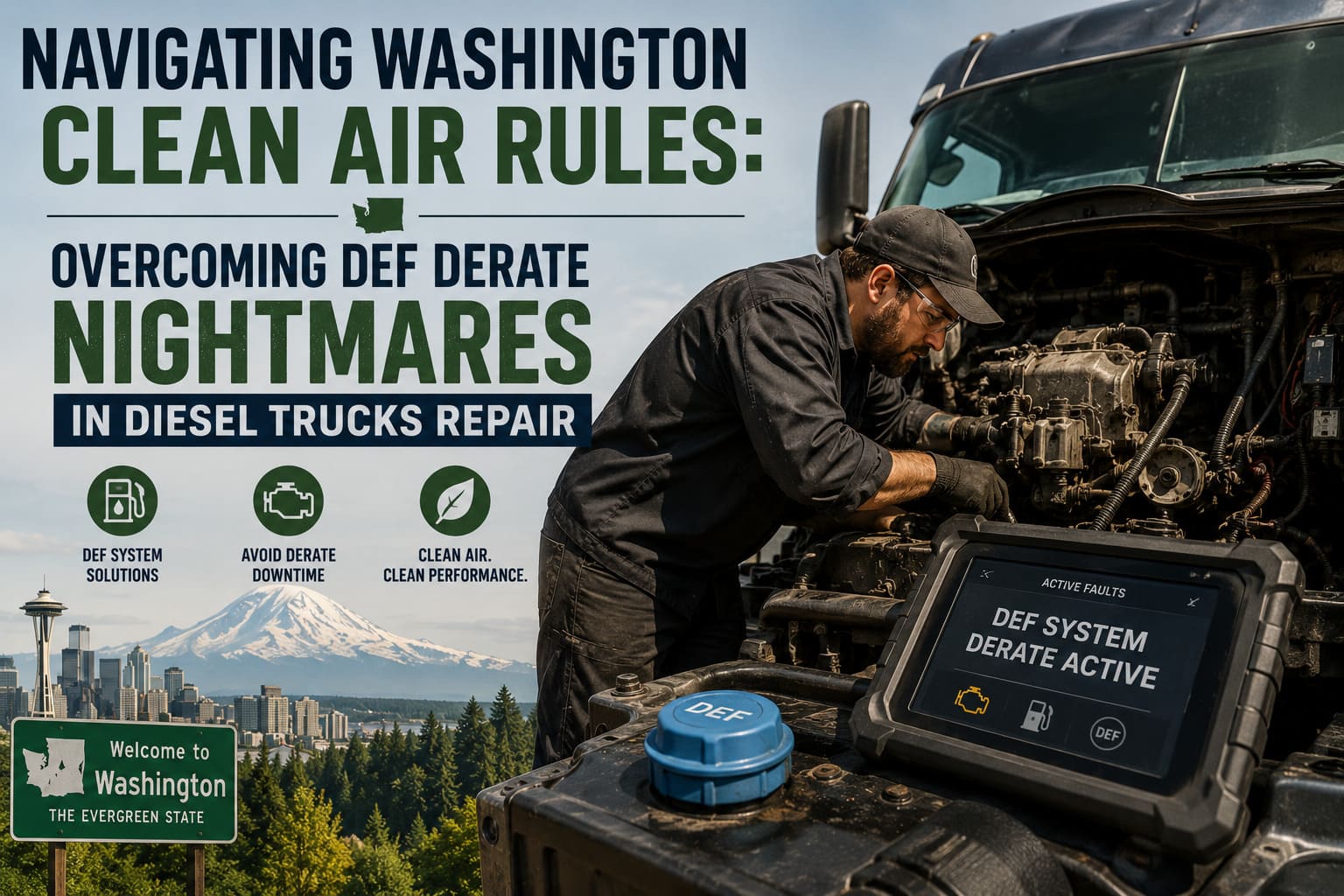
For owner-operators and fleet managers, few dashboard warnings provoke as much anxiety as an illuminated amber emissions light accompanied by an active countdown timer warning of an impending engine speed derate. When an emissions fault compromises the Selective Catalytic Reduction system, sourcing prompt and accurate diesel trucks repair becomes the difference between delivering your freight on time or watching a valuable rig crawl along the shoulder of Interstate 5 at five miles per hour.
Businesses across the Pacific Northwest depend on Williams Diesel LLC, a proven and reliable service provider in Seattle and surrounding Washington corridors, to resolve complex emissions faults, restore lost horsepower, and keep commercial vehicles running cleanly and reliably.
Clear your emissions codes and get back on the road—chat with our diesel technicians on WhatsApp for a free quote.
Washington Clean Air Mandates and the Reality of Modern Aftertreatment
Washington state has long prioritized environmental conservation, actively adopting emission policies designed to minimize diesel particulate matter and nitrogen oxide output. For diesel truck owners, this regulatory focus means that original equipment manufacturers must integrate complex aftertreatment assemblies into every modern chassis.
The heart of modern emissions compliance centers around two primary systems working in sequence: the Diesel Particulate Filter, which traps unburned carbon soot, and the Selective Catalytic Reduction assembly, which injects Diesel Exhaust Fluid into the exhaust stream. When operating correctly, this chemical reaction transforms harmful nitrogen oxides into harmless nitrogen and water vapor.
However, the operating environment of the Pacific Northwest creates distinct challenges for these delicate systems. Stop-and-go metro traffic through Seattle prevents exhaust systems from reaching the high continuous temperatures required for self-cleaning cycles. Meanwhile, persistent coastal humidity and wet winter road spray expose sensitive exhaust wiring harnesses, temperature sensors, and fluid lines to constant environmental degradation.
Anatomy of an Engine Derate: How the ECM Takes Control
An engine derate is not a mechanical failure of the engine block, pistons, or crankshaft. Instead, it is an electronic safeguard programmed into the Engine Control Module by federal and state environmental mandates. When the onboard diagnostic system detects an unresolved emissions anomaly, it initiates a phased restriction protocol designed to compel the driver to seek immediate mechanical attention.
The process typically unfolds in clear, escalating phases:
- Warning Stage: The check engine light illuminates alongside an emissions symbol or a text warning such as “Exhaust Fluid System Fault.” The driver is given an operational window, typically calculated by operating hours or remaining highway miles.
- Speed and Torque Restriction: If the underlying issue is not verified and cleared within the allotted timeframe, the computer restricts engine power output by twenty-five to forty percent. The truck struggles to pull loaded trailers up mountain grades and loses passing acceleration.
- Severe Derate Mode: Once the grace threshold expires, the system engages its most restrictive safety state. The vehicle speed is electronically capped at five miles per hour, rendering the truck undriveable on public highways and requiring immediate towing or roadside intervention.
Primary Culprits Behind DEF System Failures
Understanding what triggers a derate allows fleet operators to address mechanical problems before the computer limits vehicle mobility.
1. DEF Crystallization and Clogged Injectors
Diesel Exhaust Fluid is an aqueous urea solution comprising thirty-two and a half percent high-purity urea and sixty-seven and a half percent deionized water. While highly effective at neutralizing emissions, urea is chemically prone to rapid crystallization whenever water evaporates.
Leaking seals, worn delivery line fittings, or minor pressure drops allow fluid to pool and dry outside the intended exhaust stream. Over time, white, chalky urea crystals encrust the spray nozzle. Performing a professional def dosing injector cleaning clears hardened crystalline buildup, restores correct spray dispersion patterns, and ensures proper chemical atomization inside the decomposition pipe.
2. Contaminated or Degraded Fluid
Diesel Exhaust Fluid has a finite shelf life that degrades rapidly when exposed to direct sunlight or ambient temperatures exceeding eighty-five degrees Fahrenheit. Additionally, fluid stored in unsealed containers or pumped using dirty funnels can introduce minute quantities of diesel fuel, motor oil, or tap water into the storage tank. Even a fraction of a drop of petroleum contamination will damage the internal rubber seals of the dosing pump and ruin the chemical sensitivity of the fluid quality sensor.
3. Tank Header and Heater Malfunctions
Because DEF freezes at approximately twelve degrees Fahrenheit, manufacturers equip storage reservoirs with internal electric heating elements and engine coolant loops. During winter journeys over Washington mountain passes, the computer monitors fluid thaw rates closely. If an internal heater coil fails or the internal temperature probe shorts out, the vehicle registers a severe system fault, assuming the dosing system is frozen and inoperable.
4. Upstream and Downstream NOx Sensor Degradation
The engine control unit relies on dual ceramic Nitrogen Oxide sensors—one positioned at the turbo outlet and another at the SCR catalyst discharge—to calculate real-time chemical conversion efficiency. Because these sensitive probes reside directly in the scorching, turbulent exhaust path, they face constant exposure to thermal shock, vibration, and sulfur contamination. When a sensor’s internal sensing element loses calibration, it transmits erratic voltage signals, misleading the computer into diagnosing an SCR catalyst failure.
The True Path to a Permanent Fix: Why Code Clearing Fails
When faced with a ticking derate countdown, many drivers turn to handheld consumer code scanners in an attempt to erase the trouble code and resume their journey. In modern commercial trucks, simple code clearing almost never works.
Environmental regulations require that emissions trouble codes remain locked until the engine computer independently verifies that the fault has been corrected. This verification demands a rigorous, automated diagnostic cycle that cannot be satisfied by simply cycling the ignition key.
To execute a lasting diesel truck derate fix, a certified technician must connect high-level diagnostic software directly to the vehicle communication port. The technician reads live freeze-frame data, tests pump pressure thresholds, verifies sensor resistance values, and inspects the physical components for physical damage or wiring abrasions.
Once the defective component is repaired or replaced, the mechanic initiates a software-driven stationary regeneration and an electronic SCR system verification test. The engine runs at high idle under computer control for thirty to sixty minutes, heating the catalyst to operating temperatures and actively measuring fluid dosing volume and NOx reduction. Only when the onboard computer verifies correct emissions numbers through its internal algorithms will it permanently cancel the countdown and restore full horsepower.
Professional Fleet Solutions and Mobile Field Service
Commercial operations cannot afford to have heavy assets idle for days in dealership backlogs. Choosing an independent specialist familiar with regional hauling demands ensures swift, dependable results. In areas like King and Pierce counties, securing certified seattle truck repair provides operators with fast access to skilled technicians who specialize in diagnosing electrical communication errors, injector timing problems, and aftertreatment failures.
When an unexpected breakdown occurs far from a service bay, finding dedicated truck repair seattle wa professionals who offer rapid mobile response eliminates unnecessary towing expenses. Mobile service units equipped with advanced diagnostic hardware can reach stranded vehicles at distribution centers, job sites, or freeway staging areas, resolving sensor malfunctions and performing forced system verifications on location.
Specialized providers such as williams truck repair deliver comprehensive diagnostics and repairs tailored to high-mileage commercial haulers, preventing recurring emissions headaches and keeping trucks generating revenue.
Bridging Operational Gaps with Equipment Rental
A sudden emissions breakdown on a critical service vehicle or primary towing truck threatens overall project deadlines. When an unexpected derate or complex diagnostic requirement takes an essential vehicle out of service for several days, forward-thinking contractors turn to short-term equipment rental solutions to maintain operational momentum.
Access to heavy-duty replacement trucks, earthmoving machinery, and specialized transport units allows construction firms, utility crews, and logistics managers to fulfill active contracts without incurring costly client penalties. Instead of rushing repairs or operating compromised machinery, utilizing rental machinery provides the working room needed to ensure that permanent truck repairs, fluid purges, and component replacements are completed thoroughly and correctly.
Proactive Maintenance: Protecting Your Fleet from Emissions Derates
Preventing emissions failures is substantially less expensive than repairing them on the side of a busy interstate. Incorporating a few foundational practices into your routine operational schedule significantly extends component lifespan:
- Use Fresh, Certified Fluid: Purchase DEF certified by the American Petroleum Institute (API) and verify manufacturing date codes to ensure the fluid has not degraded during extended storage.
- Keep Fill Equipment Clean: Designate dedicated, clean funnels and nozzles exclusively for DEF, storing them in dust-free containers to avoid introducing dirt or oil into the vehicle tank.
- Inspect Wiring and Ground Connections: Salt spray and moisture cause galvanic corrosion on chassis ground straps and sensor connectors. Have technicians inspect and apply dielectric protective coatings to exposed harness plugs during scheduled oil changes.
- Address Warning Lights Promptly: Never ignore an early emissions warning. Addressing an erratic sensor or minor dosing irregularity while the truck remains fully operational prevents an unexpected drop into five-mile-per-hour limp mode.
- Perform Periodic High-Load Highway Runs: Vehicles subjected to continuous city idling benefit immensely from extended, high-speed highway hauls under load, allowing passive exhaust heat to burn away accumulated soot and urea deposits naturally.
Finding Trusted Diesel Support Across Washington
Whether managing a regional distribution fleet, an independent long-haul rig, or heavy construction equipment, every operator needs a dependable mechanical partner on speed dial. Knowing where to locate reliable diesel repair near me ensures that seasonal temperature drops, heavy rainstorms, and unexpected electrical gremlins do not derail your schedule. When serious problems arise on the road, partnering with an experienced shop specializing in diesel truck repair near me provides the certainty that skilled professionals will diagnose the root mechanical cause rather than simply masking symptoms with temporary software resets.
Frequently Asked Questions
Why does my diesel truck display a DEF warning even when the fluid tank is completely full?
An illuminated DEF warning on a full tank typically points to a malfunctioning fluid quality sensor, an open circuit in the tank level float assembly, or a failed tank heating element. If the internal sensor cannot verify proper fluid density or temperature, the computer assumes the fluid is contaminated or frozen, triggering a system warning regardless of physical fluid volume.
Can I drive my commercial truck while the engine is in derate mode?
While the engine will physically run during an early derate stage, continuing to operate the vehicle under heavy load is not recommended. Driving with restricted horsepower and compromised exhaust parameters increases thermal stress on the turbocharger and accelerates soot accumulation inside the DPF. Once the vehicle enters severe derate mode, vehicle speed is capped at five miles per hour, creating a serious safety hazard on public roads.
How often should the DEF dosing injector and filter be serviced?
Under normal regional operating conditions, the dosing injector should undergo visual inspection and cleaning every thirty thousand to fifty thousand miles to clear external crusting. The inline DEF pump filter should be replaced according to manufacturer intervals, typically between one hundred thousand and one hundred fifty thousand miles, or sooner if fluid contamination is suspected.
What is the average local response time for mobile diesel service calls in Seattle?
For emergency roadside and on-site commercial requests across the greater Seattle metropolitan area, average mobile dispatch response times typically range between sixty and ninety minutes, depending on active highway traffic conditions and the specific vehicle location.
What geographic regions throughout Washington does Williams Diesel LLC service?
Williams Diesel LLC provides shop and field support across Seattle, Tacoma, King County, Pierce County, and adjacent transportation corridors connecting Puget Sound ports to regional mountain passes and industrial hubs.
Conclusion and Final Thoughts
Navigating Washington’s rigorous environmental landscape demands diligence, technical understanding, and zero tolerance for deferred maintenance. Modern diesel aftertreatment systems are engineered to protect air quality, but their intricate electronics, sensitive chemical reactions, and aggressive computer fail-safes leave no margin for error. Experiencing an unexpected emissions derate does not have to result in days of lost revenue or compromised delivery contracts. By understanding the mechanical causes of DEF system faults, following proactive maintenance routines, and partnering with experienced technicians, fleet managers can conquer regional routes with complete confidence.
When your business requires thorough, dependable, and affordable diesel trucks repair, having local professionals in your corner makes all the difference. Williams Diesel LLC remains committed to providing industry-leading diagnostics, high-caliber component repairs, and responsive mobile support throughout Seattle and the greater Washington region. Whether you are battling an active derate countdown or scheduling preventive fleet maintenance, rely on william diesel and their dedicated team at diesel llc to resolve complex mechanical challenges and keep your heavy-duty vehicles performing at their best.


Comments are closed