


Summary
- Mitigating Mechanical Contagion: Discover how rapid commercial mobile truck repair halts the “domino effect” of engine failure.
- Cost-Benefit Mastery: Learn why on-site diagnostics are significantly cheaper than towing and catastrophic engine overhauls.
- Specialized Expertise: Understand the technical difference between a general fix and professional commercial mobile truck repair.
- Regional Protection: See how Williams Diesel LLC supports Seattle fleets with rapid, mechanic-first roadside interventions.
- Uptime Optimization: Explore how preventing secondary damage keeps your delivery schedules intact and your drivers safe.
In the high-stakes world of commercial logistics, a stationary truck is a liability that grows by the minute. When a heavy-duty vehicle pulls over to the shoulder of a busy highway, the immediate concern is usually the missed delivery window or the logistics of a recovery tow. However, seasoned fleet managers know that the most significant threat isn’t the downtime itself—it’s the mechanical “contagion” occurring under the hood. The primary failure, whether a ruptured hose or a faulty sensor, is often just the first domino.
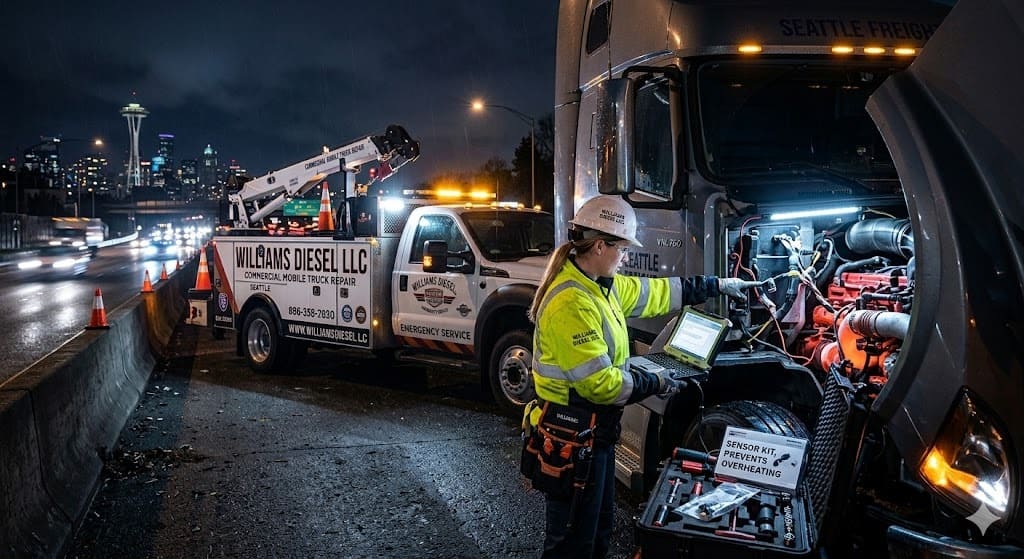
If left unaddressed or forced to drive “just a few more miles,” that minor glitch can trigger a cascade of secondary engine damage. This is precisely why commercial mobile truck repair has evolved from a simple convenience into a vital defensive strategy for modern fleets. At Williams Diesel LLC, we specialize in providing high-level commercial mobile truck repair in Seattle, focusing on immediate technical intervention to ensure a small fault doesn’t turn into a total engine write-off.
Start a WhatsApp chat and grab your free quote today :
The Anatomy of a Mechanical Domino Effect
Diesel engines are marvels of synchronized engineering. They operate under extreme heat and pressure, relying on a delicate balance of lubrication, cooling, and air management. When one component fails, the stress is immediately shifted to surrounding systems. This is the origin of secondary damage. For instance, a simple coolant leak might seem manageable, but as the engine temperature rises beyond its threshold, it begins to warp cylinder heads and compromise the structural integrity of the head gasket. By the time the driver notices the steam, the repair bill has likely tripled.
Professional commercial mobile truck repair acts as a surgical intervention. Instead of forcing a compromised engine to limp toward a shop—further grinding down metal-on-metal components—a mobile unit brings the diagnostic suite to the vehicle. This “mechanic-first” approach stops the damage at the source. It’s the difference between replacing a $50 belt on the roadside and replacing a $15,000 engine block three days later.
Financial Logic: Towing vs. On-Site Diagnostics
Many operators hesitate to call for mobile service because they fear the “on-site” premium. However, a true cost-benefit analysis reveals that mobile commercial truck repair is almost always the more affordable path. Consider the alternative: a heavy-duty tow for a semi-truck in the Seattle metro area can easily cost upwards of a thousand dollars before the vehicle even enters the shop. Once there, the truck often sits in a queue for days, losing revenue while waiting for a bay to open.
When you engage a specialized service like Williams Diesel LLC, you are bypassing those logistical bottlenecks. Our technicians arrive with the same dealer-level diagnostic software found in fixed facilities. We can perform “forced regens” on your DPF system, replace fuel injectors, or fix air system leaks right where the truck stands. By eliminating the tow and the wait, commercial mobile truck repair keeps your capital working rather than sitting in a tow yard.
Protecting the “Aftertreatment” System
One of the most common victims of secondary damage in modern trucks is the Diesel Particulate Filter (DPF) and the Selective Catalytic Reduction (SCR) system. These are incredibly expensive components that are highly sensitive to how the engine burns fuel. If an engine is experiencing a turbocharger fault or an EGR (Exhaust Gas Recirculation) malfunction, it begins to produce excessive soot.
If a driver continues to operate the vehicle under these conditions, that soot quickly clogs the DPF. What could have been a simple commercial truck repair involving a sensor or a valve becomes a nightmare involving the replacement of an entire exhaust aftertreatment system, costing five figures. Mobile technicians can diagnose these “soft” faults early, clearing codes and fixing the mechanical root cause before the exhaust system is permanently poisoned.
The Role of Precision Machining and Roadside Calibration
It is a common misconception that mobile repair is only for “light” tasks like tires or jump-starts. In the Pacific Northwest, commercial mobile truck repair in Washington frequently involves complex electronic and mechanical calibrations. Modern diesel engines are governed by Engine Control Modules (ECMs) that require precise data to manage fuel atomization.
A technician specializing in commercial truck repair can perform on-site calibrations that ensure your engine isn’t “over-fueling”—a condition that leads to carbon buildup on valves and pistons. This level of technical mastery ensures that the engine isn’t just “running,” but running within its optimal thermal and mechanical window. Protecting the “iron” of the engine through digital precision is a hallmark of high-quality mobile service.
Handling Unexpected Impacts: Commercial Truck Collision Repair
While mechanical failures are the primary focus, the road also presents physical hazards. Minor fender-benders or debris impacts can damage external components like radiators, charge air coolers, or steering linkages. While major structural work requires a shop, many aspects of commercial truck collision repair can be triaged or even finalized on the roadside to get a vehicle moving again.
For example, a cracked radiator after a minor impact will lead to immediate overheating and secondary engine seizure. A mobile technician can assess the cooling system’s integrity, perform temporary bypasses if safe, or replace the damaged cooling modules on-site. This immediate response prevents the “collision” from becoming an “engine failure,” keeping the repair costs strictly limited to the external bodywork and cooling components.
Regional Challenges: The Seattle Terrain and Weather
Operating heavy machinery in Washington means dealing with steep grades and high humidity. These factors put extra strain on braking and cooling systems. When a truck is hauling a full load up a steep incline and a cooling fan fails, the window for intervention is measured in seconds, not minutes.
Having a partner like Williams Diesel LLC means you have experts who understand these regional stressors. We know that a truck stalled on a grade in the Cascades is under more stress than one on a flat highway in the Midwest. Our approach to commercial mobile truck repair takes these environmental factors into account, ensuring that our fixes are durable enough to handle the specific “wear-and-tear” patterns found in our corner of the country.
FAQ Section
How do I know if my truck needs a mobile repair or a full shop visit?
If you see a “Stop Engine” light, strange knocking noises, or sudden power loss (derate mode), do not drive it. A mobile technician can diagnose the fault on-site. If it’s a major internal mechanical failure, they will tell you. However, roughly 75% of roadside issues—including sensors, fuel, and air systems—can be resolved without a shop.
Does Williams Diesel LLC provide 24/7 support for Seattle fleets?
We prioritize our local commercial partners and strive to provide rapid-response times. Our mobile units are specifically equipped to handle the heavy-duty needs of trucks operating in and around the Seattle metro area.
Is mobile repair more expensive than going to a shop?
When you subtract the cost of a heavy-duty tow and add the value of “saved time” (uptime), mobile repair is almost always more cost-effective. Furthermore, preventing secondary engine damage saves you from the massive costs of an overhaul.
What specific engine brands can you repair on the roadside?
Our diagnostic tools are compatible with all major heavy-duty brands, including Cummins, Detroit Diesel, PACCAR, and Volvo/Mack. We can read dealer-level codes and perform advanced bi-directional tests.
Can mobile repair help with “Limp Mode” or DEF issues?
Yes. DEF and SCR faults are some of the most common reasons for roadside service. We can diagnose sensor failures and perform forced regenerations to get your truck out of limp mode and back to full power.
Conclusion: Trusting the Experts with Your Uptime
In an industry where the margins are thin and the deadlines are tight, you cannot afford to let a minor mechanical issue snowball into a catastrophic failure. The true value of professional commercial mobile truck repair is the protection it offers to the heart of your vehicle. By intervening early, with the right diagnostic tools and a deep understanding of diesel mechanics, you ensure that your engine remains a long-term asset rather than a short-term liability.
At Williams Diesel LLC, we are more than just a repair service; we are a strategic partner for your fleet’s success. We provide the reliable, professional, and affordable commercial mobile truck repair in Seattle that keeps Washington’s supply chain moving. Whether you are looking for commercial truck repair shops near me for routine work or need a master technician to meet you on the shoulder of the interstate, we have the skills and the dedication to get the job done right. Don’t risk the “domino effect” of engine damage—trust the experts who know how to stop it in its tracks.


Comments are closed